
Way back in the sixties, I remember reading of a study that set out to establish what was different about F1 drivers. It seems that, in spite of subjecting the drivers to every test they could think of, the scientists could find only one aspect that marked out F1 drivers from ordinary mortals - they blinked far fewer times per minute than we do.
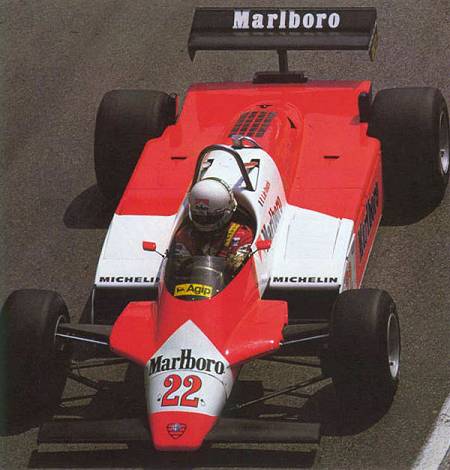
Andrea de Cesaris in the Alfa Romeo 183T
That might stand to reason, implying as it does that F1 drivers need to keep their eyes open and concentrating when things around them are happening at so great a speed. But I'm not sure that we could turn the matter around and select drivers only from those few of the population who have an abnormally slow blink rate. There might be those who would deliberately stop blinking in order to be amongst the chosen!
What it means, of course, is that there is no way to look at a guy and judge him as F1 material. The sport's heroes differ enormously in approach, character and motivation, they just blink less. We could suggest qualities that we expect in a driver but even then we run into difficulties with defining what we mean by a quality.
Take courage, for example. Stories abound about Nigel Mansell's bravery, my favorite being one of his earliest races for the Lotus team. I forget which race it was but the fuel tank leaked and Nigel found himself sitting in a seat soaked in gasoline. The fuel ate away at the skin on his back agonizingly but our Nige continued and finished the race.
But what of the sort of courage displayed by the little-regarded Andrea de Cesaris? There is no doubt that he was way out of his depth in F1 and team members would talk of how he would emerge from a hot qualifying lap white-faced and trembling, he had scared himself so much. Surely that is incredible courage, that he could push himself to compete for year after year. He had money, as is so often pointed out, and did not need to race for his living.
The urge to compete is another quality often mentioned and there is surely no finer example than Gilles Villeneuve. He would race anything that moved and spent most of his career hauling ill-handling cars far higher up the grid than they deserved to be. Yet is such determination any more to be valued than the cold, calculating skill of a Prost who waits until circumstances turn his way before giving of his best?
And what of the drivers whose hopes of being champion have died? What is the motivation behind the long careers of drivers like Riccardo Patrese and David Coulthard, employed for their experience and consistency rather than through any thought that they would suddenly break through and win races again?
They are a mixed bunch, F1 drivers, probably just as diverse as the rest of the population. From the cigarette smoking, outspoken Keke Rosberg to the finely-tuned, ultra-fit machine that was Michael Schumacher, from the nice guys like Rubens Barrichello to the glowering Jean Alesi, from the jokers like Johnny Herbert to the monosyllabic Kimi Raikkonen, all human life is represented in the paddock of F1. All that we can say of them is that they all know how to throw a car around a track pretty quickly. Perhaps that is enough and it is good that there is no answer to the question posed by the title of this post. We can never define the requirements for driving an F1 car and it remains an enigma as to why some succeed and others do not.
Except that the ones who get there blink a lot less...