
There were two big stories over the weekend, both of which I am going to ignore. The first, the disgusting display of xenophobia put on by the Spanish crowd at Barcelona, has been debated elsewhere and there is general agreement that it must be stopped now before it infects F1 further; there is little left for me to say except to add my agreement. And the second concerns Bernie's threats of removing the Australian GP from the calendar, something that annoys me so intensely that I had better let that one stew a while before saying anything that I might regret later.
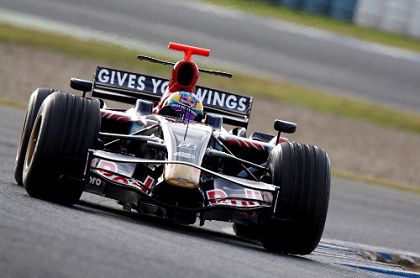
Sebastien Bourdais - can he see where he's going?
Instead, we could take a look at the "shoulder pads" the cars are wearing this season, those bulges on the sides of the cockpit expected to fend off any flying David Coulthards that might decide to use your car as a landing stage. It looks doubtful to me that they will give adequate protection in the event of such an accident, since the driver's helmet still protrudes above the bulges, but perhaps the idea is that a good clout to the helmet will knock the driver down into his seat and so ensure his safety. I will take the FIA's word for it in this case, anyway, and accept that they are a step in the right direction.
What strikes me more forcibly about the bulges is the effect they must have on the driver's vision. Anyone who has played an F1 simulation game on a PC or console knows that the great difficulty with them is the lack of peripheral vision. Without the visual information from the sides that we get in real life, it is extremely hard to assess position, speed and attitude of the car at any given moment.
Strangely enough, this makes the video racing game a close replica of the real thing as experienced by the race driver. Over the years, his vision has been whittled away until now he is expected to drive the car at its limit while looking through the equivalent of a mail slot. The full face helmet was the first to affect the driver in this way, although its influence upon peripheral vision could be lessened somewhat by turning the head slightly in the desired direction. The drivers got used to it.
The next thing that happened was the disappearance of the windshield. This had never been something that the driver actually looked through; it was too low for that and functioned more as a wind deflector that bounced the airstream over the cockpit and so prevented the driver's head from being buffeted around too much. But the invention of the airbox dictated that aerodynamics around the driver's head become more sophisticated - it was imperative that air be directed into that scoop and the windshield was interfering with its easy passage.
So the driver was moved lower and the windshield became token at first, then a painted facsimile, until it disappeared altogether. But the important point for our purposes in this article is that the driver began to disappear into the body of the car.
When aerodynamics insisted that the nose of the car be raised, his vision became even more limited. Suddenly he was looking out over a flat section of bodywork that drooped down slightly only beyond the front suspension. No longer could he see the road a few yards in front of the car - he depended now upon his view of the top half of the wheels and a sense of where the road went next, gained more from memory than direct vision.
And now we limit his vision even further by placing the bulges on either side of him. It is inevitable that a car attempting to pass will have to be right alongside before entering what remains of the driver's peripheral vision. That might cut down on arguments of which car was ahead at the entry to a corner but only because the one in front had no idea that the other was there at all!
What surprises me in all this is that, to the best of my knowledge, there has been no hint of disapproval from the drivers, no complaint that vision has become so limited that the car is impossible to drive. Clearly, the will to race in F1 is strong enough to overcome such objections and each generation accepts the handicap of decreasing vision as a fact of life.
I do wonder where it will end, however. Will they have to lay the driver down head first in the end and give him a little slot in the nose to peer through? Or maybe they should forget the real world entirely and put a screen in front of him, a television screen fed by inputs from various points on the car. Or they could feed the TV input straight to the pits and the driver could sit in the motorhome, driving the car through a hand controller.
Oh, wait a minute, that's called a video game, isn't it? Except that this is F1 so we dress it up with the much fancier title of simulator. I can see it now: the Simulation GP of Singapore, 2017, points counting towards the World Simulation Drivers' Championship! Oh, brave new world, let me not look too closely - limit my vision, please!