
Over at F1 Fanatic, Keith Collantine has sparked a lively debate by pointing out that Kimi Raikkonen and Felipe Massa seem to disagree about the effects of banning traction control (TC). I have had my say on the matter in an earlier post, but I find it interesting that the prime objection to the ban is that it decreases safety.
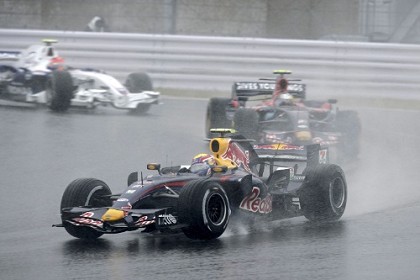
Racing in the rain
And so we come to the old question of how safe we can make F1 before it becomes no more exciting than a video game, where the consequence of a mistake is a loss of time only. In the 2007 season we saw how the creation of large paved run-off areas has meant that a driver falling off the circuit can just drive back on again, at times even gaining an advantage from his mistake. Various suggestions have been made to ensure that off-track excursions have to be paid for in some way but this does illustrate the fact that there is a balance to be sought between safety and fair competition.
It would be easy enough to make the cars so safe that injury, let alone death, becomes almost impossible. Kubica's Canadian GP accident shows just how strong the survival cell in an F1 car is these days and we could add to that by insisting on enclosed cockpits and even more front end protection (remembering that Kubica's feet were visible at the broken end of the cell after the crash). We could enclose the wheels to prevent their contact with other cars (contact between open wheels being invariably the cause of the car taking off) and add stability control to TC and other electronic driver aids. But would it still be Formula One?
The sport is a compromise between two major aspects: the skill of the driver and the technical excellence of the car. When either one of these becomes too important, F1 degenerates into something else entirely. Place too much importance on the competition between drivers and you end up with a spec series; allow technology to be the deciding factor in winning races and the human interest disappears - one might as well remove the drivers and allow the technical wizards to compete for designing the best robot.
Certain aspects of the cars are retained because, without them, the sport ceases to be what we know as F1. The prime example is the open wheel, without which the car becomes a sports car. Open wheels will be retained even though they are probably responsible for more accidents than any other factor, especially when we take into account the fact that they are the culprits behind the enormous amounts of spray thrown up in wet races.
So we already accept that safety will always be compromised in F1; there are limits to the quest for safety beyond which we will not go. And traction control is the present battleground where we seek to define a limit, a reasonable balance between safety and competition between drivers.
Let us not forget that, until recently, the F1 community was virtually unanimous in wanting to get rid of TC. The reason is obvious - TC takes away some of the responsibility of the driver to ensure that his wheels do not spin and lose traction. In other words, more skill is needed to drive without TC and it is skill that we are interested in when we watch F1.
Now, suddenly, some of the drivers are expressing doubts about the wisdom of banning TC. Safety is the excuse, the likelihood of more accidents being pointed out and the difficulties of handling the car in the wet. But let us get this in perspective.
TC has been in and out of the sport for over a decade now, but there was a time when the cars were more powerful and had no TC whatsoever - the turbo era. Somehow the drivers coped and nobody suggested that there would be fewer accidents if TC were to be introduced. It is not as if today's drivers were being asked to do anything that hasn't been done before, therefore, and they will do it in cars that are much more crash resistant than in the past. If safety is compromised at all, it is by such a small amount as to be negligible.
Yet the balance between skill and technology will have been altered in the right direction. For years we have been complaining about technology being increasingly the deciding factor in the sport; now we have a situation where that trend has been reversed at least a little. There is even some hope that the best drivers will be able to use their talents to rise up the grid a place or two.
And, make no mistake, "the best" means those who cope best without TC. Car control is what we are talking about and having the courage to floor the throttle and let the TC handle the results has nothing to do with skill.
It seems to me that there is far too much fuss being made about the ban on TC. It is most likely that the fans will notice no difference at all, while the drivers will quickly adapt. In a year's time it will be a dead issue, only to raise its head once again if some clever designer finds a way to sneak it back in through some unnoticed loophole in the regulations. Safety may have been compromised but only minimally - and the benefits to the sport far outweigh any slight increase in the risk of accidents.
Racing in the rain
And so we come to the old question of how safe we can make F1 before it becomes no more exciting than a video game, where the consequence of a mistake is a loss of time only. In the 2007 season we saw how the creation of large paved run-off areas has meant that a driver falling off the circuit can just drive back on again, at times even gaining an advantage from his mistake. Various suggestions have been made to ensure that off-track excursions have to be paid for in some way but this does illustrate the fact that there is a balance to be sought between safety and fair competition.
It would be easy enough to make the cars so safe that injury, let alone death, becomes almost impossible. Kubica's Canadian GP accident shows just how strong the survival cell in an F1 car is these days and we could add to that by insisting on enclosed cockpits and even more front end protection (remembering that Kubica's feet were visible at the broken end of the cell after the crash). We could enclose the wheels to prevent their contact with other cars (contact between open wheels being invariably the cause of the car taking off) and add stability control to TC and other electronic driver aids. But would it still be Formula One?
The sport is a compromise between two major aspects: the skill of the driver and the technical excellence of the car. When either one of these becomes too important, F1 degenerates into something else entirely. Place too much importance on the competition between drivers and you end up with a spec series; allow technology to be the deciding factor in winning races and the human interest disappears - one might as well remove the drivers and allow the technical wizards to compete for designing the best robot.
Certain aspects of the cars are retained because, without them, the sport ceases to be what we know as F1. The prime example is the open wheel, without which the car becomes a sports car. Open wheels will be retained even though they are probably responsible for more accidents than any other factor, especially when we take into account the fact that they are the culprits behind the enormous amounts of spray thrown up in wet races.
So we already accept that safety will always be compromised in F1; there are limits to the quest for safety beyond which we will not go. And traction control is the present battleground where we seek to define a limit, a reasonable balance between safety and competition between drivers.
Let us not forget that, until recently, the F1 community was virtually unanimous in wanting to get rid of TC. The reason is obvious - TC takes away some of the responsibility of the driver to ensure that his wheels do not spin and lose traction. In other words, more skill is needed to drive without TC and it is skill that we are interested in when we watch F1.
Now, suddenly, some of the drivers are expressing doubts about the wisdom of banning TC. Safety is the excuse, the likelihood of more accidents being pointed out and the difficulties of handling the car in the wet. But let us get this in perspective.
TC has been in and out of the sport for over a decade now, but there was a time when the cars were more powerful and had no TC whatsoever - the turbo era. Somehow the drivers coped and nobody suggested that there would be fewer accidents if TC were to be introduced. It is not as if today's drivers were being asked to do anything that hasn't been done before, therefore, and they will do it in cars that are much more crash resistant than in the past. If safety is compromised at all, it is by such a small amount as to be negligible.
Yet the balance between skill and technology will have been altered in the right direction. For years we have been complaining about technology being increasingly the deciding factor in the sport; now we have a situation where that trend has been reversed at least a little. There is even some hope that the best drivers will be able to use their talents to rise up the grid a place or two.
And, make no mistake, "the best" means those who cope best without TC. Car control is what we are talking about and having the courage to floor the throttle and let the TC handle the results has nothing to do with skill.
It seems to me that there is far too much fuss being made about the ban on TC. It is most likely that the fans will notice no difference at all, while the drivers will quickly adapt. In a year's time it will be a dead issue, only to raise its head once again if some clever designer finds a way to sneak it back in through some unnoticed loophole in the regulations. Safety may have been compromised but only minimally - and the benefits to the sport far outweigh any slight increase in the risk of accidents.