
There seems to be a general consensus that Toro Rosso should replace both its drivers for 2008. Apart from the fact that everyone seems to think Liuzzi and Speed have underperformed (and I'd like to know how that is assessed, there being no telling how good or bad the car is until we see an experienced driver in it), it would actually be bad policy for the team to start again with two new drivers. Just ask Toyota.
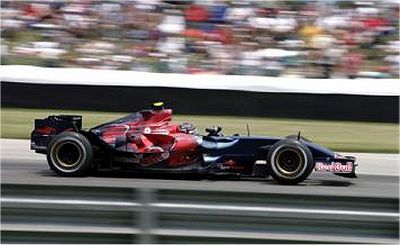
Scott Speed at the USGP
The Japanese company seems to be in the habit of sacking drivers as a team and then throwing new ones together. Their initial choice, Mika Salo and Allan McNish, was rather good and most F1-watchers were surprised when both were replaced after a year. For that second year, 2003, Toyota took on Oilvier Panis and Christiano da Matta, a slightly odd pairing but justifiable at least. Panis had never been as quick after breaking his legs in the Montreal accident of 1997 but he had the advantages of experience to offer the team; da Matta had been very successful in Champ Cars but was still an unknown quantity - too many have failed in F1 after taking that route.
These two stuck for a couple of years, occasionally showing that the car had promise but not making any breakthroughs into the big time. Then, in 2005, Toyota came up with their dream team, the super-qualifier Jarno Trulli and the eternally-promising Ralf Schumacher. In contrast to previous years, the company has been loyal to this pairing and Trulli has rewarded them by generally finishing races as well as he qualifies. In the meantime, Ralf has been a disappointment and is unlikely to be retained next year.
Looking at Toyota's driver strategy, one has to say that their biggest mistake has been to kick out both drivers when wanting a change. There is no continuity as a result and it becomes hard to assess the performance of the new drivers. It is said that Mika Salo did not get on with the management and that is why he left but, had the team kept McNish for a second year, they would have had an idea of whether their new signing was any quicker.
Panis outperformed da Matta but was he really in the top flight at the time? It is impossible to say. And now there are Trulli and Ralf, the Italian making the German look really bad after a long struggle between them, but again we don't know how much is due to the car and how much to the drivers. It could be that Trulli is working wonders with a dog or that the car flatters his racing.
Next year I presume that Ralf will be off on his travels and that Toyota will employ one of the new hopefuls to team up with Trulli. Then we will be able to make a fair assessment of real abilities, both of the car and the drivers.
But the point is that changing two drivers at the end of a season is not good policy. And, if Toro Rosso do not want to follow Toyota down the underachieving road, they would be well advised to keep one of their present drivers. Whether that should be Liuzzi or Speed is a matter of opinion - and you know mine already...
Scott Speed at the USGP
The Japanese company seems to be in the habit of sacking drivers as a team and then throwing new ones together. Their initial choice, Mika Salo and Allan McNish, was rather good and most F1-watchers were surprised when both were replaced after a year. For that second year, 2003, Toyota took on Oilvier Panis and Christiano da Matta, a slightly odd pairing but justifiable at least. Panis had never been as quick after breaking his legs in the Montreal accident of 1997 but he had the advantages of experience to offer the team; da Matta had been very successful in Champ Cars but was still an unknown quantity - too many have failed in F1 after taking that route.
These two stuck for a couple of years, occasionally showing that the car had promise but not making any breakthroughs into the big time. Then, in 2005, Toyota came up with their dream team, the super-qualifier Jarno Trulli and the eternally-promising Ralf Schumacher. In contrast to previous years, the company has been loyal to this pairing and Trulli has rewarded them by generally finishing races as well as he qualifies. In the meantime, Ralf has been a disappointment and is unlikely to be retained next year.
Looking at Toyota's driver strategy, one has to say that their biggest mistake has been to kick out both drivers when wanting a change. There is no continuity as a result and it becomes hard to assess the performance of the new drivers. It is said that Mika Salo did not get on with the management and that is why he left but, had the team kept McNish for a second year, they would have had an idea of whether their new signing was any quicker.
Panis outperformed da Matta but was he really in the top flight at the time? It is impossible to say. And now there are Trulli and Ralf, the Italian making the German look really bad after a long struggle between them, but again we don't know how much is due to the car and how much to the drivers. It could be that Trulli is working wonders with a dog or that the car flatters his racing.
Next year I presume that Ralf will be off on his travels and that Toyota will employ one of the new hopefuls to team up with Trulli. Then we will be able to make a fair assessment of real abilities, both of the car and the drivers.
But the point is that changing two drivers at the end of a season is not good policy. And, if Toro Rosso do not want to follow Toyota down the underachieving road, they would be well advised to keep one of their present drivers. Whether that should be Liuzzi or Speed is a matter of opinion - and you know mine already...