
The FIA International Court of Appeal has now released its findings in the double diffuser appeal and it has to be said that it is a model of rational legal thinking. To put it in a nutshell, it cuts through the crap.
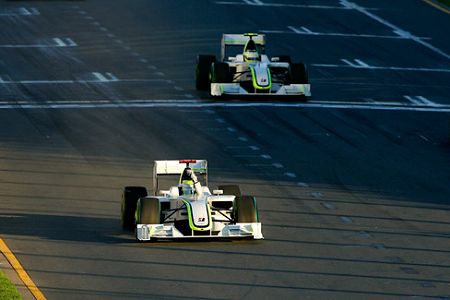
Brawn GP win in Australia
Considering how far the protesting teams went in their efforts to manufacture a reason to ban the double diffuser, the court has done exceptionally well in dismissing their various points. In particular, there is one decision that has important implications for the future: the response to the Sixth Plea, that The Decision of the Stewards is Inconsistent with Previous Statements Rendered by the FIA. The court's view is interesting enough to be considered in full.
85. The Court observes that opinions of the Technical Department, while performing a vital role, are advisory in nature and are not Technical Regulations. Teams are obliged to comply with the TR as written. It is for the Stewards, and ultimately this Court, to offer binding interpretations of the TR. Even if the Contested Decisions were inconsistent with any opinion of the FIA Technical Department (which has not been established), this would not give rise to the invalidity of the Contested Decisions. The Court therefore denies the Sixth Plea.
This clarifies the relationship between the FIA's Technical Department and the stewards, together with the ICA itself. Only the court and the stewards can rule on the legality of tweaks to the cars and the FIA's opinion is just that - an opinion. Asking the FIA about something you want to design into your car is therefore a bit like asking a lawyer for guidance; he can give you an idea of the likelihood of winning your case but there are no guarantees.
Suddenly it appears pointless for the teams to ask the FIA for advice on the legality of any development to their designs. Every F1 engineer has to study the regulations in great detail and so his opinion on the boundaries of legality is likely to be much closer to the truth than anything the FIA might think. What matters is the opinion of the stewards and the ICA and neither Max Mosley nor Charlie Whiting can give a guarantee on legality.
That is how it should be. In democratic government the laws are made by one body but it is another that interprets them and, apparently, this is exactly what happens within F1 too. Our only quibble should be that the system leads to nothing being decided before the season begins and subsequent long waits while the court is convened to decide upon any contentious matters.
This is obviously unfair to the teams trying to work within the rules and has the potential for unnecessary expense in the losers having to spend extra money on changing their cars to suit the ruling. The double diffuser saga has made it clear that there needs to be a mechanism for the court to be convened during the off season to give a ruling on such issues. After all, we have been talking about double diffusers for months and the matter could have been sorted out before the season started.
But, as Bill Shakespeare once said, "All's well that ends well." The double diffuser issue is decided and now all the teams will have to fit them if they want to stay in the hunt for the championship. BMW has yet to withdraw its protest and, theoretically, could force another hearing but the decision would be the same. Dr Theissen seems to have accepted that he must adjust the F1.09 to take a double diffuser but reckons that it may not be ready for the Barcelona GP.
That is a welcome return to good sense for the BMW motorsport boss and I am happy to hear that the team will not resort to panic measures such as an abandonment of the season for development of the car for 2010. Brawn GP may have an impressive lead in the championship after three races but the other teams can claw back that advantage now that they know what is allowed.
Early leads are pleasant to have but are no guarantee of ultimate success. In 1979, Ligier established a lead with a few wins at the beginning of the season but faded away to allow Ferrari to take the spoils at the end. There is no reason why one of the teams this year could not take the idea of a double diffuser and make it work better than Brawn's or anyone else's; in 1979 again, Williams embraced Chapman's ground effect principles and produced the FW07, the car to beat for at least two years afterwards.
It may not be the best-funded teams that use the double diffuser to best effect; without testing, much depends on luck as well as computer simulations and wind tunnels. What will matter most is speed of development and McLaren and Renault seem to have that well in hand. Ferrari too are expecting to have important developments by Barcelona, others in time for the Monaco GP.
It has potential to be a fascinating season, with designers racing in their offices while the drivers fight it out on the track. This is what F1 is really all about, competition to the utmost throughout the season. Who needs a spec series?