
For the third year in a row, Williams have produced a car that looks good in pre-season testing, then swiftly loses ground to the competition once the races start. Usually this is blamed on the team having less to spend on development than the rich teams but it does not explain the fact that the Williams disappoints even in the first race.
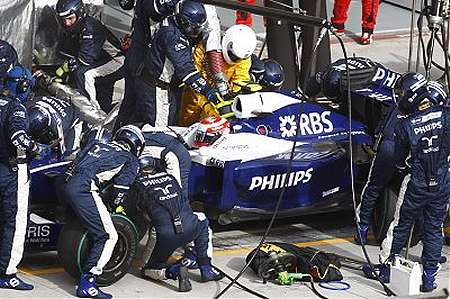
Nakajima pit stop
This year is assuming the same familiar pattern, with the lead driver, Nico Rosberg, often quickest in practice but not so competitive in qualifying and even less so in the race. In Rosberg's best race so far, the Malaysian GP, he managed to get the jump on the faster cars ahead of him at the start and led until his first pit stop. Everything went downhill from there, Button's heavier fuel load allowing him to build a big lead on Nico before he had to come in.
One is forced to the conclusion that the quick laps in practice are achieved on very light fuel loading and that the car is then fuelled too heavily to get to the front in qualifying. This leaves Rosberg several cars down on the grid and without a performance advantage to improve his position. Poor timing of pit stops has also affected Rosberg's races, too often dropping him down into traffic and his lap times suffering accordingly.
The car is good, however, and was probably the third quickest at the beginning of the season. Like the Brawn GP, it has soldiered on through the early races without development but it is still about fourth in the pecking order. The team has been unable to make inspired strategic decisions similar to Ross Brawn's and have been caught and passed by less competitive cars in the race. For instance, it makes no sense that Raikkonen should have finished so far ahead of Rosberg in Bahrain.
It begins to look like the team's inability to make the most of the car is a problem with strategy more than anything else. We also need to take into account Willams' preferred option with the second driver, Kazuki Nakajima, putting him on a heavy fuel load in the hope that a longer first stint will enable him to leapfrog drivers ahead of him. This tends to be BMW's strategy and Nick Heidfeld has often been able to improve his position through late first stops. Nakajima is no Heidfeld, however, and does not have the authority within the team to make decisions on precise timing of stops during the race.
We tend to give the Williams team a great deal of respect, thanks to their history of many championships, and I hesitate to criticize their handling of races. But the fact is that they are underperforming this season and have done so in the last few years too; it is worth making a few tentative suggestions therefore.
Historically, Williams' championships have been won with cars that had a considerable performance advantage over their competition. The one exception, ironically Nico's father's victory in 1982, was achieved through Keke's unrelenting determination and the unreliability of other cars. The cars are so unbreakable these days that it is unlikely that reliability will ever again be such an important factor - just about everyone finishes.
My point is that Williams do not have a history of winning championships with less than the best car. It should be no surprise, therefore, that they are struggling to find a way to win races against equal or slightly quicker opposition. What they need more than anything else is to shake up the strategy and try different solutions from the "one light, one heavy" idea.
For a start, a page out of Alonso's book might help. He is hauling a very uncompetitive Renault up to the sharp end of the grid by running extremely light in qualifying. This allows him to start the race near the front and to hold on to a good position until his first stop; what happens thereafter depends to a great extent on luck but at least he is throwing the dice from a higher placing than Rosberg's.
So one of the Williams cars should be fuelled very light indeed. Rosberg has demonstrated in practice that the car is good enough for pole in such conditions - in fact, there is no reason why he should not be able to pull out a considerable lead in the first stint, assuming that he converts pole into the lead of the race. The greater his lead when he comes in, the better his chances of emerging sufficiently high to regain first place when the rest take their stops.
It is worth trying Nakajima on light tanks too. His reputation has suffered through always starting the race in a heavy car but practice times show that he can be quick when given the same fuel loads as Rosberg. Competition is so fierce at the moment that he does not often make it into Q3 but when he does, it would give him a chance of defending Rosberg's lead if he were fuelled nearly as lightly.
Rosberg grabbed the lead in Malaysia but lost it when he pitted because he was unable to build a gap between himself and the chasing pack. With an even lighter tank, this could well have been possible and an early stop would not have been so damaging to his race overall.
Grid position is so important these days that it has to be worth trying an ultra-light strategy. The present formula does not work for Williams, that is clear, and a strategy shake-up could make all the difference. If nothing else, running both cars light would at least give the team a chance of getting two cars in the points.
Renault has shown that, when you have a car that is less than competitive, extreme strategies can lift it above its true potential. Williams may not have a driver of quite the ability of Alonso (the jury is still out on Rosberg) but they have a better car than the R29. It seems to me that Williams need to break out of their established pattern and consider new strategies, the ultra-light idea being just one that is worth trying.
Having solved all Williams' problems, I must now confess myself a bit baffled by Toro Rosso. While Red Bull are demonstrating that the latest Adrian Newey design is one of the best in the field, STR seem incapable of getting much out of it and generally end up playing amongst the Force Indias (and BMWs in Bahrain). Is this a driver problem or is the team not getting the best from the car?
Buemi has looked pretty handy in the early races but that may be thanks to Bourdais having three bad ones. I cannot believe that Le Seb is that much worse than a rookie with a less-than-stellar record in the lower formulae and Bourdais' race in Bahrain would seem to indicate that I am right. Obviously, Team Seb has a less gifted driver line-up than its sister team but that is not sufficient to explain RBR being one of the leaders while STR languishes near the back.
All sorts of possible answers occur and most of them could have a part to play in STR's poor performance so far. Luck may be an important influence, maybe Vettel has set up skills that RBR now benefit from while STR suffers from their absence, perhaps the improvements to the Renault engine have made it a better power plant than the Ferrari. It is an enigma that will probably only be solved as the season progresses.
Turning to Force India, one has to say that they have definitely arrived. Although they failed to get into Q2, they were on the pace in the Bahrain GP and beat a few other cars. The Mercedes engine has made some difference, no doubt, but the car itself is good enough to take advantage of it. And, when one considers that the entire grid in Bahrain was covered by a second and the difference between fastest race lap and slowest was only two seconds, it is clear that mere hundredths separate the Force India cars from their competitors.
The team has made improvements to the car during the early races and will be introducing more before the Barcelona GP. It may well be that progress is in the right direction and the breakthrough to Q2 will come in Spain. I hope it does, as the team has shown considerable ability in closing the gap to the rest so quickly.
Of course, that will mean that some other drivers may have to take their turns at the bottom of the timing sheets. I do not want to even think about who those might be and ask only that Dr Mario lift the BMWs out of the danger zone immediately!