
I think there can be no doubt that Toyota had the fastest car in Bahrain, and that by a considerable margin. They did everything right before the race, Trulli producing one of his specialty laps to get pole by nearly half a second, Glock backing him soundly by taking the other spot at the front of the grid. It was all that was required for the team to take its first ever win and, when the two Toyotas retained the lead at the start, victory should have been there for the taking. So what went wrong?
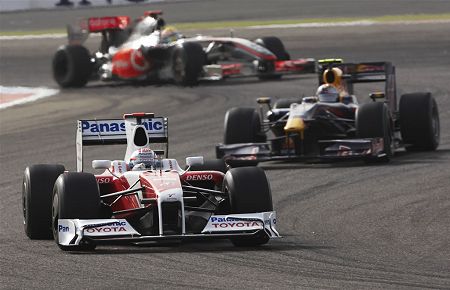
Jarno Trulli - third is not enough...
Toyota's John Hewett gives us the answer in an interview published in Autosport, as if it were not obvious to everyone: strategy scuppered the team's race from the moment the cars came in for their first pit stop. But the signs were there even before that moment, the most significant being that it was Glock who had grabbed the lead at the start, not Trulli.
Regardless of Timo's reputation as being a better racer than Jarno, events were to show that Trulli was the quicker of the two throughout this race. With Glock in front, Jarno could do nothing but follow his team mate through the first stint, with all the consequences to his tires that Vettel mentioned in explaining his inability to pass Hamilton in the same period. That prevented Jarno from getting the gap to Button that he really needed if the Toyota's light fuel strategy were to pay off. Jenson stayed close enough to put in some quick laps when the Toyotas went in and emerged from his own stop in the effective lead.
Team orders may be illegal in terms of F1 regulations but a more experienced strategist would have found a way to maximize the advantage of having both cars at the front. And there were reasons why the team should have chosen Jarno as the man to lead from the start. He is quicker than Glock over one lap at least, has more experience and is less likely to make a mistake through excitement therefore; and the famous Trulli train demonstrates his ability to keep faster cars behind, something that was bound to become important once the cars swapped to the harder tire. Timo was also going to have to stop sooner and so was the more likely to run into traffic problems thereafter.
It may sound like hindsight, but Trulli should have been chosen to lead the race and Glock to act as rear gunner, slowing the chasing pack to allow Trulli to build the lead he needed to stay in front through the first pit stops. Three laps into the race, the situation was clear - Button was the big danger, Vettel having been neutralized by Hamilton, and the team needed Trulli to get to the front. A brief "mistake" by Glock could have arranged that quite neatly and then the rest of the plan come into play.
Even had the team been unwilling to alter the order so cynically, the alternative was to get Jarno to slow sufficiently to limit Button's pace, thereby allowing Glock to pull away. It is a team sport, after all, and the important thing was to grab the win so temptingly on offer. Toyota's F1 presence may well depend on them achieving a win this year and they were fools to let their best chance yet slip through their fingers through strategic mistakes.
Of course, the decision to run a long second stint on the prime tires turned out to be a huge misjudgement but, with better management of the early laps, the damage inflicted could have been limited. We saw in the second stint how Trulli could keep Vettel behind, even though the Toyota was considerably slower on the hard tires. It is easy to dissect things afterwards like this but that is the point about great strategists like Ross Brawn - they see beforehand how the race is likely to go, devise a plan to make best use of that, and then tweak the strategy as the race develops. Toyota sat back and let events unfold, disastrously as it turned out.
Having said all that, it is encouraging that John Howett seems to have learned the lesson. He admits the error and is likely to be a bit more cynical when looking at strategy in future races. My fear is that it may be too late; Toyota may never again have as big an advantage as they had in Bahrain. Barcelona is big upgrade time for all the teams and new challengers are bound to emerge.
Turning to Renault, it has to be said that their car is not nearly as good as Flavio would have us believe. Alonso did his best, putting on a brave show of defending his position and re-taking lost places but it was not enough; one point was little reward for the hard work he put in on Sunday.
A more realistic view of the Renault's capability was given by Piquet. He has had a hard time so far this year, with most commentators not taking into account the fact that he did not have the upgrades provided to Alonso until the Bahrain GP and the resultant pressure encouraging mistakes. But in this race he had a car equal to Alonso's and gave himself hope by using it as well as could be expected. In the process, he provided us with a useful yardstick to the car's true performance - it is good for about tenth place.
Whether this will prove enough to ensure Piquet's survival in the team is doubtful. Rumor has it that he has two more races to show what he can do and so a much more consistent performance is necessary from now on. One more instance of throwing the car off the road may well be the end for him.
So interesting was the Bahraini GP from a strategic point of view that it is worth having a look at some of the other teams too. What is going wrong at Williams, and what of Toro Rosso and Force India, for instance? I will save that for tomorrow, however, as it needs more thought; expect a part two, therefore.
And thereafter I guess it will be all about McLaren's fate in the WMSC hearing...