Renault are celebrating thirty years of F1 involvement (occasionally out but mostly in) since their first GP victory in the modern era. That was the French GP at Dijon in 1979, a race won by Jean Pierre Jabouille in the RS10 but more usually remembered for the terrific battle for second place between Gilles Villeneuve in the Ferrari 312T4 and Rene Arnoux in the other Renault. So famous is that wheel-bashing fight that it is often reported as being for the lead - poor Jabouille's win is so overshadowed by what was happening behind him. We get a few seconds of him crossing the finish line in the standard YouTube video of the race.
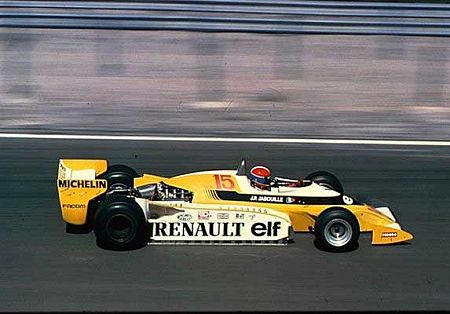
Jean Pierre Jabouille in the Renault RS10
That Renault's historic victory was outstaged in such a manner was somehow indicative of the company's future relationship with F1. After spearheading the turbo revolution in the late seventies and early eighties, the Renault team failed to secure a championship and often alienated the drivers who gave them their best shot at such an achievement. Jabouille, who had put in the hard work for years to make the turbo competitive and reliable, was dumped at the end of 1980 in favor of the rising French star, Alain Prost.
Arnoux, too, found himself squeezed out after one season partnering Prost, the two Frenchmen proving a rather volatile combination. And then the team fell out with Prost after he was narrowly beaten to the 1983 championship by Nelson Piquet. The '84 and '85 cars were never really competitive and the company closed down its team after experiencing financial problems. It supplied engines during 1986 but then withdrew altogether until its return as an engine manufacturer in 1989.
Those were the great years of the company, both Williams and Benetton winning championships when powered by Renault, but again the costs proved a bit too painful for the manufacturer - it withdrew at the end of 1997. Being Renault, however, it could not stay away and, in 2000, it bought the Benetton team to re-enter the game. With Flavio Briatore at the helm, the team proved rather better at driver management and won the 2005 and 2006 drivers and constructors championships.
It is a tale of fluctuating fortunes and varying degrees of commitment from the board of directors - even today, no one really knows whether Renault will stay the course this time or drop out in the face of hard economic times. But the company can look back on some great innovations such as the introduction of turbo power in 1977 and the production of the first 3.5 liter V10 in 1989, both of which changed the face of F1. It is a pity that scope for engine development is so limited these days for it seems Renault's destiny to come up with new and unusual ideas in that area.
Until 2012 when the engine rules change, it remains to be seen whether the team continues in the sport, especially now that its current mantra, Fernando Alonso, seems likely to be in a Ferrari next year. Rumor has suggested a Briatore buy-out of the team if Renault decide to withdraw but I would not count too much on that one; the Flav has said before that he would like to retire soon. So Renault assumes the mantle of team most likely to withdraw in the near future, Toyota having proved surprisingly tenacious in that regard.
I, for one, would be sorry to see them leave. The team has been an important aspect of F1's appeal over the last few years, unpredictable as it is, and they lead the way in reaching out to an increasing fanbase through innovative web techniques. It must be the most fan-friendly team of all and that is not just through the entertainment value of Flavio's press releases and occasional outbursts!
Here's hoping for another thirty years of Renault in F1.