
Predictably enough, the WMSC has been lenient in the Renault race-fixing case, handing out a suspended ban on the team and doing what they could against the identified culprits, Flavio Briatore and Pat Symonds. Clearly, the first part is to ensure that Renault do not withdraw from F1 and is understandable, at least. In the case of Briatore and Symonds, the court could do no more than prevent them being present or involved in any FIA-sanctioned events in the future as its power does not extend beyond motor sport.
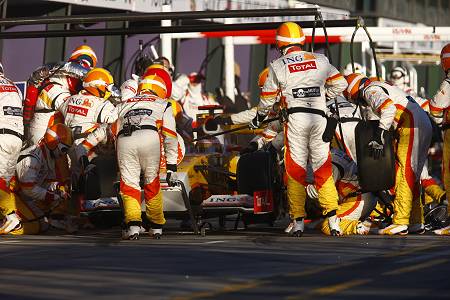
The Renault F1 team
Many are saying that the sentence is far too light and that it illustrates, yet again, how the governing body favors one team over another; McLaren's $100 million fine is cited as an example of draconian punishment for a crime that was far less than Renault's misdeeds. That the court has been lenient cannot be disputed but I find it difficult to criticize it, given the circumstances. The sport is not dependent upon Renault's continued participation yet the withdrawal of its engines would create difficulties for other teams in the short run and take F1 one more step along the path to standardization.
So the decision may be viewed as unfair but it was necessary. That the FIA should consider the future of the sport at all is unusual enough to be remarked upon; we should breathe a sigh of relief that it has not tried to establish some sort of parity with the McLaren penalty. In itself, this is a tacit admission that the McLaren punishment was excessive and imposed merely because the company could stand it.
Note that the McLaren fine is always the comparison when we feel the FIA has been unduly lenient towards other teams. It stands out as a massively inappropriate penalty for an offense that was never proven and relied purely upon one man's assumptions. This is what makes the Renault judgement seem so soft - had the original WMSC decision on McLaren been allowed to stand, we would have had no cause for complaint now. It is not so much that the FIA has been easy on Renault but rather that it was ridiculously hard on McLaren.
One other case is sometimes cited as an example - the ban on Toyota when their rally team was caught cheating. Against this, we can set the lack of any real punishment of Benetton when it was found that they had removed the filters from their fuel rigs. That there is wild fluctuation between penalties handed out by the WMSC cannot be disputed and we are entitled to suspect that personal preferences may be involved. Can it be coincidence that Briatore, a friend of Mosley's, was the Benetton team manager at the time they were caught cheating and that there was known to be no love lost between Mosley and Ron Dennis?
We should take heart from the fact that Mosley's reign as FIA President is drawing to a close, therefore. For far too long he has run the sport in a way that gave no confidence in the decisions of the FIA, damaging the image of F1 in the eyes of the public and leaving the teams unsure of the rules and the penalties for breaking them.
Some expect that Jean Todt will win the election and we might end up with even worse government of the FIA; but that is a little hard on Todt and there is still a good chance that Ari Vatanen will beat him. And, if Ari wins, you can bet that things will improve quickly.
It is enough for the present that Renault's continued presence in F1 has been guaranteed by the WMSC verdict and the signing of the Concorde Agreement. Yes, it may seem a bit unfair that the company has escaped serious penalty but the sport is the better for it, at least until the new teams have settled in and we can see who makes the grade and who doesn't.
A new future dawns and it is time to start putting the Mosley era behind us. Hanging on to the injustices of the past will only sour our experience of F1 as it works towards a better day.