
I see that Marko Asmer and Lucas di Grassi have been left out in the cold as regards F1 this year. Both have seemed quite exciting prospects for the future but have found their continued progress up the ladder blocked by the virtual extinction of the genuine test driver. Asmer was supposedly a test driver for BMW in 2008 and di Grassi performed the same duties (or lack of them) for Renault but the restriction on testing meant that they rarely had a chance to sit in the cars. With testing banned during the coming season, the role of test driver becomes a matter of a title without any function.
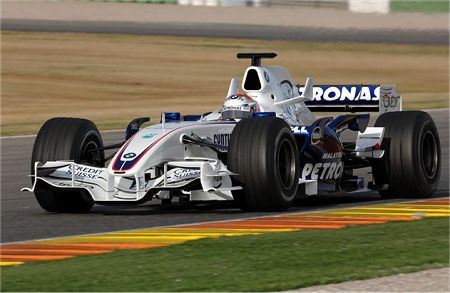
Marko Asmer testing for BMW last year
Only eighteen months ago I speculated on the possibility of test driving becoming a recognized specialty in F1; that has now been scuppered by the regulations for 2009. As long as the ban continues, there will be no point in teams employing a third driver to help with the development of the car - which sounds like bad news for young hopefuls like Asmer and di Grassi since they will have no opportunity to impress team managers with their speed during test sessions.
In fact and as I have mentioned before, it is debatable whether a year in a testing role does anything for a new driver's preparations for F1. The rookies of the last couple of seasons have shown that being thrown straight into the deep end (Hamilton, Nakajima) may actually be a better way to enter the formula than through test driving (Kubica, Kovalainen, Piquet). It is tempting to think that a year without competing in some sort of racing blunts the competitiveness of a new driver and that this outweighs any advantage in getting to know the characteristics of a F1 car.
So Asmer and di Grassi may have been done a favor by the F1 teams' lack of interest in them; they need to find drives in GP2 (for instance) in 2009 and hope that a good performance there will force attention upon themselves.
It does leave the team managers having to take a bit more of a chance when selecting new drivers however. With only a record in lower formulae and a brief test run or two in the winter to go on, the boss will have to gamble on a rookie's ability to cope with the extra demands of F1. Not all drivers find the step up easy and some fail ever to settle in - Jan Magnussen springs to mind.
Not that I think this will prove too onerous a task for team managers; they have worked within such a system before and can do so again. Things can be a little more complicated now than they used to be, especially in a year like 2008 where the competition in the lower formulae has not been particularly inspiring and the most outstanding factor amongst young hopefuls has been the name of a famous relative. Nelsinho Piquet is a very obvious warning not to give such dubious factors too much weight!
The matter of choosing a new driver is unlikely to be a major element of the team manager's job in the next few years anyway. That bumper crop of rookies in 2007 and 2008 has resulted in almost a complete turnover of driver personnel in the sport and future changes will be more a matter of swaps and reshuffles than the entry of new blood. Smaller grids mean fewer seats and so those already in the club will be competing for drives amongst themselves; new boys will have to wait for the rare occasion of a seat remaining unfilled.
And that means the youngsters will have to spend more time in the lower formulae, which gives more time for outstanding talent to develop and be recognized. The modern trend of younger and younger drivers making it through to F1 may well be halted in the coming years and the entrance age begin to ascend again. Sebastian Vettel might hold on to his record of the youngest driver in a GP for a lot longer than we expected.
F1 has always gone through cycles like this. Nearly fifty years ago the youngest driver to enter the sport, Chris Amon, was only a few weeks older than was Vettel at the Indy GP of 2007. In between those years there were times when few new drivers entered the sport and others when a sudden crop of rookies produced claimants for the position of youngest ever (Mike Thackwell, Rubens Barrichello).
So Marko and Lucas need not despair - their chance will come, no doubt. It is just that they may have a slightly longer wait than they expected and that might well turn out for the best in the long run. It did Fangio no harm to wait until he was 37, after all.