
Keith Collantine has begun an interesting debate on whether F1 is a sport, sparked by the Indian Minister of Sport's assertion this week that it is not. Although I agree with Keith that the statement was really an excuse to avoid paying for an Indian GP, the question is fundamental to F1's future. For once, the fans' view of it is not important; of much more significance is how it is seen by the wider public who know little but what they read of its political and financial battles in the newspapers. And the plain fact is that most people think of it as an expensive entertainment created by and for petrolheads.
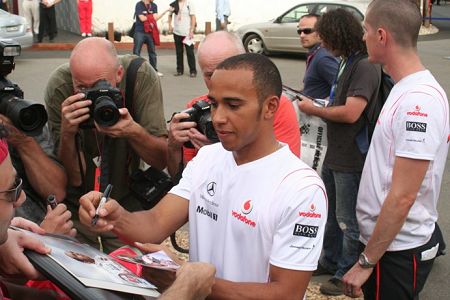
Lewis Hamilton meets the fans
As mentioned in at least one comment on Keith's article, the attempt to define F1 as a sport is a matter of semantics more than anything else and recourse is made to the dictionary definition: "an activity, pastime, competition, etc that usually involves a degree of physical exertion". By that definition, it is a sport, if only for the drivers.
Things are far more complicated than that, however. We can see that sport is an important factor for the drivers but it is also their livelihoods, just as it has become in other sports. And what of the teams, the designers and managers, mechanics and caterers? Can F1 be defined as a sport from their perspective? I think we have to resort to the word "competition" when it comes to team members since many team functions do not require physical effort (and what of chess, defined sometimes as a sport? Must we include mental effort in our definition of sport?).
Yet there is an undeniable entertainment aspect to F1 as well; television companies would not be forking out huge sums of money for the right to broadcast races were it not entertaining enough to attract millions of viewers. Business comes into it too, with wheelers and dealers like Bernie Ecclestone and Flavio Briatore making large sums of money through their involvement in the affair.
It all becomes meaningless to limit our perception of F1 to sport or entertainment or business. It is all those things and probably many more - politics springs to mind, for one. And what value is there in deciding on a single definition of it anyway? Just because an Indian politician has decided that it does not warrant government investment because it goes beyond being a sport (but no more so than cricket, please note), that does not mean we should attempt to prove otherwise.
Matters go awry when we try to define F1 as one thing rather than anything else. Just as our politician junks it as "not a sport", others, such as Briatore, seek to make money from it by defining it as entertainment. And the car manufacturers want it to be a testing ground and marketing tool. None of these narrow views of it are correct and yet it is all these and more too.
It is when we see F1 as entertainment, business or sport only that our vision of its future becomes distorted. Concentrate too much on one aspect and the others will suffer, leaving us with something that is not F1. As far as I can see, the one essential aspect is competition between both individuals and teams - and that, surely, must be defined as sport. On the day the drivers become irrelevant and all that matters is that the viwers be entertained or that more money is made by those involved, on that day will F1 have died.
And I have said what I wanted but am left with an illustration that I was determined to include yet found nowhere to fit in. The intention was to illustrate something about sport but now I am not quite sure that it does. It is an amusing story, however (and might begin frenzied debate on blood sports), and I am compelled to add it as a silly end piece. The connection with F1 is tenuous at best and I can only suggest that, if you want F1 only, read no further.
As a schoolboy in Africa, I became involved occasionally in something we called ant lion fights. The ant lion is a creature a little bigger than an ant (but not by much) and it catches its antish prey by digging a conical pit in sandy ground. It then buries itself at the deepest point of the pit, the apex of the reverse cone, and waits for some unhappy ant to fall into the pit. As the ant scrabbles to climb the crumbling walls, the ant lion pounces from beneath the sand and grabs it with its ferocious jaws.
It was those pincers that made up the ant lion's jaw that fascinated small boys, no doubt. Almost as big as the body of the insect, they promised fierce battles if used upon another similarly armed. And so ant lion fights were organized, the poor creatures scooped from their hiding places and put together, prodded and poked until, in sheer desperation and annoyance, they would reluctantly fight. I do not recall whether any of these battles ever came to a satisfactory conclusion but the game held our attention for brief moments.
And was it a sport? By our definition, I suppose that we could say that it was for the ant lions, unaggressive as they were towards each other. Recourse to the gladiators of Roman times might be necessary to justify our definition, however. And gladiators were participants in something always known as "the games". So maybe there is a difference between a game and a sport, although I am not sure that reluctance to participate is always a constituent of a game.
It becomes complicated, doesn't it? Almost as complicated as that thing we call F1...