
I find it quite surprising that, to the best of my knowledge, no one has questioned the FIA's announcement that the manufacturers will be allowed to "re-tune" their engines to establish equality. Does it not occur to anyone that this is both an admission that the engine freeze has not worked and that the goal of the FIA is standardization? Where in the regulations does it state that engines must have the same power output?
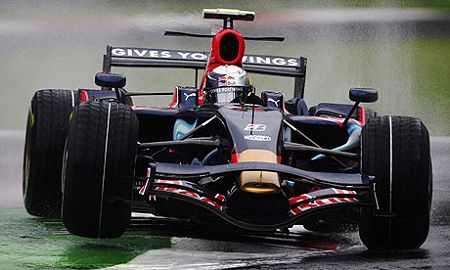
The Toro Rosso becomes a race winner at Monza 2008
When the engine freeze was first introduced, Mosley justified its timing by saying that all the engines were about equal anyway. Nobody argued, although Honda obviously hoped to gain a small advantage by rushing through a few tweaks immediately before the freeze came into effect. It was reasonable to assume, therefore, that the race for more power from the engine was over and that customers could be fairly sure that, whatever engine they put in their cars, it would not be the difference between winning and losing.
Then we began to hear muttering about the Ferrari engine somehow having increased in power and this was backed up by Toro Rosso's sudden ascendancy over its Renault-powered sister team, Red Bull. At the end of last year, the FIA confirmed this power disparity by allowing Renault to make a few "adjustments" to its engine to re-establish parity. But it occurred to some of us that the only explanation for the sudden increase in Ferrari power was that they has already made changes to their engines in spite of the freeze.
On closer inspection, we found that a loophole had been used. The regulations allowed changes for reliability reasons and Ferrari had sneaked in a few that increased power. That the tweaks were never intended to assist reliability was illustrated by the increase in Ferrari engine failures in subsequent races; if reliability had been the goal, the engineers had made some serious errors!
It is suspicious, at least, that the FIA never noticed this and turned a blind eye to other teams, BMW and Mercedes for instance, using the same loophole to keep up with Ferrari. One has to conclude that the governing body was not serious in its intention to prevent changes in the engines and that the excuse of cost-saving was a nonsense. If manufacturers were allowed to sneak in power increases under the guise of reliability, the game was still on and no money was saved.
This year it seems that Mercedes have found some "reliability" tweaks that have given its engine more power, making it the engine of choice for all customers. And the FIA has decided to allow changes that bring parity between the engines again but under the proviso that power output will be decreased in the better engines, rather than letting the lesser engines increase their oomph. If that does not reveal the true aim of the regulations, I do not know what can.
Clearly, the idea behind the engine freeze was never a saving in costs; it was always a way to standardize engines, making it irrelevant which particular lump you chose to stick in your chassis. It was a measure designed to accustom us to the idea of parity so that there would be less opposition to the spec formula that Mosley wanted to see in F1. Those who care about diversity in the sport must surely protest at the creeping standardization that is going on or we will have a sort of GP1 formula in the end, like it or not.
The lesson from all this is that engine freezes do not work as long as there are several manufacturers involved. Any engineer worth his salt will look for loopholes and ways to improve his engine - F1 is all about competition and the engine designers are as competitive as anyone else involved in the sport. It is time to recognize the illogical mess that the freeze has turned into and allow development again.
And, if one engine gets the jump on the others to produce more power, has that not always been the case in F1? The Matra and Ferrari V12s were always much powerful than the Cosworth V8 but the customer teams coped by designing better chassis. The Renault turbo produced far more power than the rest when first introduced but was betrayed by awful reliability. Engine power parity is, in fact, not something to be desired in F1; it is the very difference between engines that encourages fresh and innovative approaches from the engineers and designers.
Let them compete - it is the only way if we want to preserve the sport.