
Gerhard Berger is much in the news today after his recent vocal support for Max Mosley's continued tenure as FIA President. The rumor of Berger's candidacy for Max's position is a bit unlikely, given that the STR manager is not free until the fate of that hapless team is decided; that will not happen until next year so, if there is any truth in the story, Gerhard must be thinking in terms of Mosley's survival to the autumn of 2009. If Mosley is voted out at the FIA meeting on June 3 this year, Berger cannot be a replacement - Alain Prost's willingness to do the job makes him a far more likely successor, therefore.
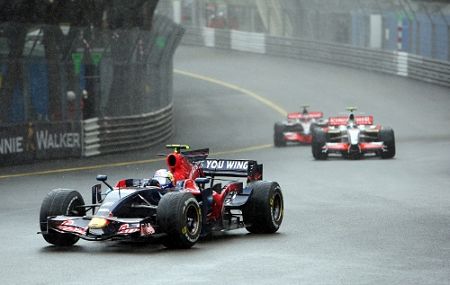
Sebastian Vettel in the Toro Rosso STR3
More interesting from a practical point of view are Berger's remarks regarding the debut of the Toro Rosso STR3. He is quite pleased with its performance at the Monaco GP, the car having lasted the race and scored points in the hands of Sebastian Vettel.
Given that the car is now openly admitted to be a Red Bull RBR4 with Ferrari engine and that it is delivered without improvements made by the parent team to date, one would have to caution Gerhard slightly over his optimism. This is the car that seemed rather fragile at first, losing its wheels in spectacular fashion when David Coulthard had the effrontery to run over a curb, remember. Even though it was subsequently passed by the stewards as strong enough, I would suggest that STR have a word with Dietrich Mateschitz about any strengthening that might be needed.
We should also recall that STRs seem to perform above expectations in the wet; why this should be so much more noticeable than it is in its sister car is unknown but might have something to do with its only variation from the RBR version - its Ferrari engine. This may introduce a slight difference in weight distribution and/or delivery of power to the wheels. If that is so, it would explain Vettel's excellent race at Monaco but would cast doubt upon the car's performance in the dry. I suspect that STR have a lot of work to do before the car becomes as competitive as they hope it will be.
This is an appropriate moment, too, to consider STR's effect on the customer car issue. Looking back to the beginning of 2007, it will be recalled that the two customer car teams looked a good deal more threatening to independents than they do now. Super Aguri were using the Honda chassis that had won a race in 2006 and STR were about to receive the first of Adrian Newey's designs for Red Bull. It is no wonder that Spyker, soon to become Force India, and Williams sat up and took notice.
Since then, the threat has proved a good deal less than was expected; SA put on a fine show by giving Honda a run for its money but did not really gather a mountain of points, and STR struggled with a difficult car that shone only in the wet. But the process had been started and resulted in the ban on customer cars that saw the end of Prodrive's attempt to enter F1 and the subsequent demise of SA. With STR now the sole representative of F1's brief flirtation with customer cars and the team's future very dubious, thanks to the unlikelihood of a buyer being found for Mateschitz's shares, it is hard to see a route for new entries to the F1 grid in the future.
The problem now confronting the sport is dwindling grids, not customer cars. And this surely highlights the fact that the concerns of the moment should not be given so much weight when considering rules for the future. It was always obvious that a ban on customer cars would make it almost impossible for new teams to enter and this should have been a deciding factor in any decisions made, not the hype surrounding one engineer's designs or the fear that a small team would do as well as its supplier.
Of course, the problem was caused by the conflict between FIA rules and the Concorde Agreement - one seemed to allow customer cars, the other did not. Which forces me to the conclusion that the Concorde Agreement should not be a regulatory document. It should be a point of contact between the teams and the FIA, yes, but the rules should remain entirely in the hands of the governing body.
And that brings me back to Prost's candidacy for Mosley's job. I never liked the little Frenchman when he was a driver but, judging by his recent remarks on how the sport should be governed, I have to say that he seems to know what he is talking about. He has seen to the root of the sport's present problems and has a clear vision of how they might be tackled - and that is more than can be said for Max Mosley, whose primary concern is to prove how naughty the News of the World has been to publish details of his sordid private life.
It is amusing how one's view on drivers can change once they retire. I used to be a great supporter of Berger's when he was driving; now I think he makes a pretty poor team manager. And, as a Senna supporter, I detested Prost as a driver but now find myself rooting for him as FIA president. It's a funny old world...