
In a very short space of time, Super Aguri has replaced Minardi as the small team everyone supports. Much of this is thanks to their showing last year, when they made their parent team, Honda, look a bit silly, especially in the first half of the year. Add to that Sato's famous pass on Alonso in the Canadian GP 2007 and their popularity becomes completely understandable. We all love underdogs, after all.
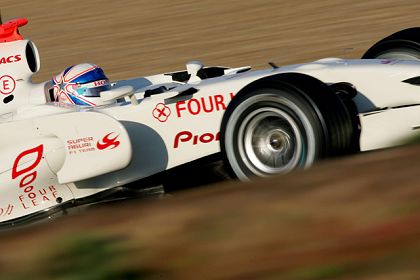
Being the awkward old fart that I am, I do not go along with the general enthusiasm at SA's achievements last year, however. Oh, I like to see the underfunded teams doing well and wish SA all the best in their present struggle to survive. But I am not hugely impressed with their performance in 2007. They were running the Honda RA106, after all, a car that had won a GP the previous year and that Honda had expended an enormous amount of effort on to make it reasonably competitive with the front runners. If SA had not been able to beat Honda's dog of a car for 2007, it would have been quite surprising.
To me, it seems that 2006 was the impressive year for Super Aguri. A team that is thrown together in a matter of weeks, has nothing but an out-of-date Arrows chassis to work on, fights through the initial ridicule at their efforts and comes through to finish in tenth spot in the final GP of the year- now that is something worth cheering about. No-one would have believed it possible at the beginning of that season.
There are far more lessons to be learned from SA's first year in F1 than in their second. For a start, Toyota should be looking very closely at the early history of the team to see what they were getting right that the Japanese giant has so far failed to do. This may be more than Toyota executive pride can cope with but they are the losers for such an inability to humble themselves.
Super Aguri is also a very clear demonstration of the fact that small teams have some advantages over the large and well-established ones. Apart from being able to react to changes very quickly, there being hardly any chain of command to go through, a small team is more likely to have a unified vision of where they are going, with fewer internecine struggles between designers.
Take McLaren as an example. It has been very successful in the past and, as a result, has become a huge complex of design departments, each with its own head and charged with different aspects of the car. But it takes a very influential designer to gather all that up and provide unity of vision for each new design. It may well be that McLaren's historical success is now working against the team and that might be the explanation for there being no championship victories in the last few years.
Adrian Newey is often cited as the last of the lone rangers, the designers who have sufficient influence and clout to be able to design the whole car. Yet even he has to work with other designers who may not share or understand his vision. It is now his third year with Red Bull Racing and we are beginning to see the fruits of his work - the RB4 is expected to be very competitive in this coming season. Ross Brawn goes to Honda and again the story is that we will see no real effect on the team's performance for a year at least.
Yet Super Aguri went from being a joke to respectable contenders in a year only. The fact that a lack of funds now holds them back detracts not at all from what they have achieved so far. It has always been true that decent funding is necessary for success in F1, but it is not the only requirement, as Toyota have found.
Aguri Suzuki is at present in Tokyo, attempting to hammer out a deal that ensures the survival of his little team. All our hopes should be with him as failure would mean much more than just the disappearance of one more team from the grid; it will underline the fact that F1 is unlikely to see any new teams entering in the near future, that the day of the small team is truly over.