
One of the things we take for granted when watching F1 is that all the drivers speak English. It is the language of F1 for historical reasons but it still surprises me that even new arrivals from feeder formulae have such a good grasp of what, for them, may be a very difficult language to learn. I know, for instance, that the Japanese struggle when it comes to learning English, so different are the two languages.
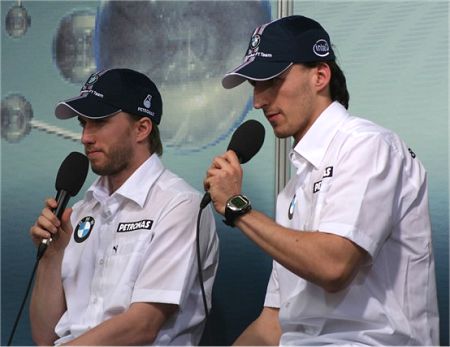
A German and a Pole field the questions
We may smile at the repeated phrases, stilted delivery and odd sentence construction of many of the drivers, but the fact is that these guys are doing far better than most of us would if forced to learn Finnish, for instance. The truth is that all of them, without exception, demonstrate considerable linguistic skill every time they appear in the interview room or are waylaid by a bunch of eager fans.
The English are known for their reluctance to learn other languages and cover their linguistic limitations with such excuses as "if I repeat it often enough, they will understand" or "I don't need to learn another language, they all speak English." The second excuse is true, but only because English is taught in almost all foreign countries, whereas the second language in British schools could be French, German or Spanish. It does not help, either, that Latin was dropped from the curriculum ages ago but that is another rant that I won't begin here.
So I admire the drivers for their mastery of English - and it should be described as mastery, when we consider that they are barraged with quickfire questions from interviewers who think nothing of constructing long rambles with a question buried in the middle. The wonder is that the drivers so rarely fail to understand, not that their answers are deliberately devoid of information that the competition might find useful. They know the company line and tread it quite ably.
Of course, the drivers get plenty of practice in English, with almost all of the teams having so many British team members and the language being the common tongue as a result. But this may not always be true. Toyota have based their team in Cologne, while BMW Sauber have lived in the German-speaking part of Switzerland for a long time. How long can it be before the German speakers outnumber British team members and the language culture changes as a result?
There can be no doubt that British influence in F1 is waning. The numerical superiority of Brits in the teams is the result of decades of British supremacy in racing but this is no longer true. None of the engines now in use in F1 are built by British companies and there is no prospect of new British engine builders in the future. As expertise in the construction of chassis and suspension spreads to Germany, Italy and Japan, these countries will supply more of the experts within the teams.
There may even come a time when it no longer makes sense for so many of the teams to be based in England. That, too, is an historical thing and there may come a time when it makes more sense for teams to be close to their manufacturer parents.
The one thing that English has going for it in terms of being the language of F1 for the future is the internet. Thanks to its being the invention and development of our cousins across the water, American English is the language of the net and is likely to remain so. And, as time goes on, F1 becomes more internet aware and so becomes subject to its imperatives.
For the moment, therefore, we can assume that F1 will continue to speak in English - and those who are native English speakers should be grateful and appreciate how this enables them to avoid the work of translation. I myself have been irritated at times by the constant repetition of the phrase "for sure" in the drivers' statements, but may I never forget that I have no right to voice any criticisms while my own language skills are as limited as they are.