
It may be a bit cruel, but I was amused by two stories last week that seemed to give rather different versions of the future. On Monday, 15th January, Autosport related how Trulli was certain that he would win a race for Toyota in 2009. Then, just four days later, came news of a rumor in Japan that Trulli would be replaced by Kamui Kobayashi for next season. Someone is using the cheaper crystal ball, methinks, but which one?
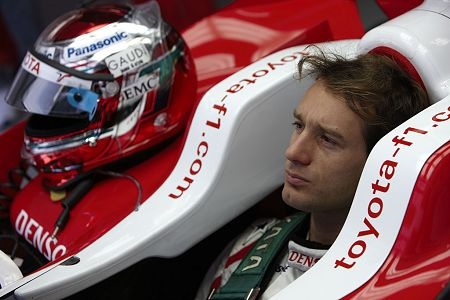
A thoughtful Jarno Trulli
Both premonitions and rumors are suspect, of course, and it remains to be seen whether either story holds the truth. But I could not help reflecting that life as an F1 driver has become rather insecure of late. Poor Trulli obviously had no idea that such rumors were about to start flying around and he might well have kept his mouth shut had he known. It is very similar to Jenson Button's rude awakening from his dreams of a better car next year when Honda announced its withdrawal from the sport.
Now both Button and Barrichello wait upon the whims of the team market to see whether they have drives in the coming season. Rubens was a bit more prepared for a shock, word being that he would be "retired" next year, but it must have been an unpleasant surprise to be put even further into the doubtful brigade so suddenly.
Then one remembers Takuma Sato and Anthony Davidson who were apparently rewarded with drives last year when it was finally decided that Super Aguri would soldier on into 2008. We all know how briefly that was true and how the drivers found themselves out in the cold after all. There are no guarantees for a F1 driver these days, it seems.
In fact, the drivers' position has worsened to the extent that they may well have to take pay cuts in the near future. With so many young drivers clamoring for seats and the credit crunch squeezing the teams' finances, drivers have little bargaining power left. Not even the world champions can expect an easy ride since their salaries form a large part of the budgets.
It is the prospect of sudden manufacturer withdrawal that must worry drivers most, however. Toyota is about to report its first ever loss on car sales and, despite recent assurances that they are committed to F1, the board may decide that their team must go. Renault, too, are always ready to depart when the sport no longer suits them and Toro Rosso has a huge question mark over its future.
Ferrari, McLaren and BMW seem reasonably safe for the moment but I have no doubt that economies on drivers' salaries will be suggested even there. And, to be honest, it is hard to feel sympathetic towards the top drivers in this situation; their pay rates have been beyond the imagination of the common man for many years now. And the old argument that sports players have to make their money while they can holds no water in F1; ex-champions seem to do very well after retirement from the sport, even those who competed when salaries were not astronomical.
It all goes to show that reality has a way of restoring balance when things get out of hand. The recent agreements on cost-cutting measures have not come about through the participants seeing reason at last - it has been the economic realities that have forced such changes upon them. One is tempted to think that change would have come whether there was agreement or not; shortage of money tends to lead to tightening of budgets whatever agreements have been made.
We may be watching the sport adjust to reality in ways that the participants do not expect. Looking at those teams most at risk, it seems that the outfits owned completely by manufacturers and without a long history in the sport are the ones most likely to sell up or disappear. That would leave a few privateers and the teams with manufacturer backing and branding but roots within smaller teams of the past. If Dave Richards succeeds in buying the Honda team, that would be one more privateer and one less manufacturer on the grid.
So the economic downturn may actually be doing F1 a favor. If it results in a form of racing more affordable to the small team, if salaries become more reasonable, if technology becomes less important and driver skill and engineering innovation regain their former ascendancy, it will be better for the sport as a whole. The time may come when we will look upon these few years as the turning point, the age when F1 reformed itself into a new and more exciting (and less political) sport and diversity became a hallmark again.