
I have always felt that, once an art form starts examining itself, it is on the way down the plughole; art must involve itself with the world and only gets out the mirror when it has nothing left to say. Take a look at the so-called avant garde of the visual arts, literature and music of today and you will see what I mean (actually, the state of modern poetry most elegantly demonstrates my point but I would not inflict such garbage on my readers).
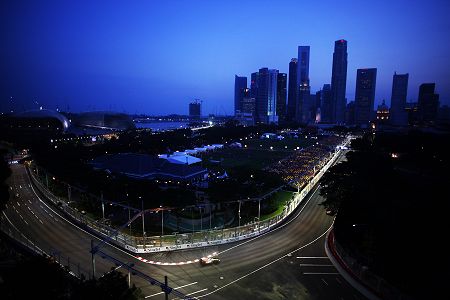
One of Renault's arty shots of the Singapore GP
Blogging is an art form, believe it or not - a brash newcomer in the world of literature where the writer has immediate response from his readers and puts himself on the line as a result. No hiding out in some New Hampshire log cabin for the blogger; he writes with the world looking over his shoulder and all his weaknesses on display!
Which is a form of introduction to my subject today: the relevance of F1 blogging to the sport. As I have said, this is far too early to be looking at blogging, barely emerged from its infancy as it is, but certain revelations from the F1 powers that be this week have drawn my thoughts on the matter into a new understanding of what is really going on.
This is all Doctor Vee's fault. He has written a scathing article on the absurd vison of the future from Martin Whitmarsh and Luca di Montezemolo - a world in which F1 is a spec series, the GP weekend is a funfair of irrelevant races only loosely connected with the main event and the teams become entertainment managers interested only in counting up the profits.
What has shocked me is the fact that the nonsense emanates from FOTA, the association of F1 teams that we must all have hoped would prove a desperately needed counterbalance to the worst excesses of the FIA. The evidence so far suggests, however, that FOTA is nothing more than a lapdog of the FIA, intended only to assist it in the dismantling of F1 to replace it with some awful sort of freak show.
How can the teams be serious in suggesting standard transmissions, wheels, brakes and rear wings? Are they really so little interested in the competition that makes F1 what it is? It seems incredible to me but two of the most important members of FOTA say it is so and I have to cope with it.
And the only way I can do that is to look at the underlying attitudes of the people in charge of the sport. It has been obvious for years that Bernie is interested only in increasing the number of viewers, since this means more money in his pocket. He cares nothing for the quality of the viewers, whether they understand the sport or are likely to stick with it in the future; it is all about profits now. The revelation is that his attitude is shared by all those who run the sport - money is what matters and the contest between man and machine that lies at the heart of F1 is disregarded and treated with contempt. The show is everything, apparently, and the sport irrelevant.
What this means is that the true enthusiast, the one who knows his history and understands the technical matters of engineering and driving, is actually an impediment to the entertainment managers of F1. The real fan is nothing but a pain in the rear end to them, since he whines on and on about the quality of the racing, the integrity of the FIA, the poorly written rules, the abject submission to the bean counters; they would happily be rid of us, dear readers, and look forward to a time when they can count the sheep through the turnstiles and attend to their shearing without a bleat of protest.
I know that sounds dramatic but it encapsulates what is happening. Consider that the suggestions for the future have been made in all seriousness - did they really think we would accept such ideas with open arms? I cannot believe that. No, they knew full well that the enthusiasts would react with horror and my conclusion must be that they do not care. They would rather have weekend viewers than purists who read the magazines, blogs and sites during the week and so have some understanding of the sport.
Which is where blogging comes into all this. With the abandonment of hope in the team owners, we are left with only the media as any sort of counter to the nightmare visions of those who think they own the sport. And the blog is perhaps the most effective means of spreading discontent with the direction desired by the greedy; certainly, it is able to say things that the traditional media dare not and so becomes a thorn in the side of the FIA and FOTA. Yes, it is a small thorn at the moment and only Max professes to read any of it, but there is no doubt that the internet is growing in power and could be the source of huge embarrassment to the F1 governing bodies in the future.
The real power lies with the people. Were they to stop watching, F1 would crumble into a shadow of its former glory and the money men would suddenly find themselves in debt up to their eyebrows. At the moment they feel omnipotent, as though we will continue to watch whatever nonsense they serve up, but that is a short term view at best; there will come a time when large numbers give up on the sport as it is dragged into the arena of the circus.
It lies with the media to continue to educate new fans as quickly as possible. What Bernie and his ilk do not understand is that the casual F1 fan soon becomes an enthusiast, that the number of informed fans is growing along with the increase in television viewers. That explosion of true enthusiasts is fueled by the media, especially the blogs, and the onus falls on them to safeguard the future of F1.
F1 Fanatic recently posted an article on the number of GPs viewed by its readers. The overwhelming majority of answers came from fans who have been watching for less than twenty years - F1 has a young and knowledgable fanbase and this is its strength for the future. If they are to be heard, then it is the blogs, with their capacity for interaction, that will be their voice.
We argue over the tiniest details, supporting one team or driver over another, but, when it comes to the big issues of what is and is not appropriate for F1, we are generally of one accord. That amounts to a powerful message to the governing bodies and they do not listen at their peril. If we are talking of the future, the F1 blog is every bit as important as the opinion of Martin Whitmarsh or Luca di Montezemolo.
Let us hope that the big names become aware of the internet before it is too late. They fob us off with team sites that are largely propaganda at the moment but perhaps they might wander beyond that one day and come across the voices of those who keep them in business. There is an old saying that he who pays the piper, calls the tune - and it really is time that F1's paying clients started to call a tune or two.