
In all the fuss over the events at Spa last weekend, Grand Prix dot com ran a little story that went largely unnoticed but is crucial to the future of F1. The Formula One Group has submitted a proposal for the continued use of customer cars beyond the end of 2009, apparently in an attempt to ensure the survival of Scuderia Toro Rosso.
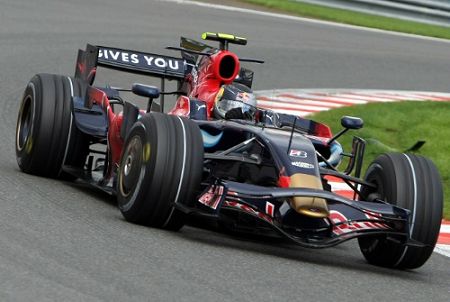
Sebastian Vettel and the STR3
Toro Rosso desperately need something of the kind, with Dietrich Mateschitz intending to sell off his share in the team by 2010 and yet a sale being virtually impossible as long as STR are faced with the costly prospect of having to become constructors in a very short time. The sport is also facing a time of dwindling numbers of teams as it becomes clear that only very large companies can afford the enormous expense of starting a new team from scratch. Rumors of possible entry by such companies as Volkswagen/Audi surface occasionally, only to be promptly squashed by the company itself.
If STR disappear after next year, the last independent teams will be Williams and Force India and the F1 grid will have shrunk to a mere 18 cars. Although the FIA is desperately trying to halt and reverse the constant increase in costs that threatens the survival of small teams, their attempts so far have met with little success. Unless the much-vaunted exercise of cost-capping proves effective beyond expectations, the days of the small constructor look numbered.
Naturally, we all want Williams to survive and prosper, their history over the last thirty years having been so studded with glorious episodes. But other great teams have faltered and failed, some (Lotus and Brabham) having been even more illustrious. The real world is a tough master and no respecter of past achievements.
Previously, it has been the refusal of Williams and Force India to hear of the legalization of customer cars that has scuppered attempts at compromise. Times change, however, and it may be that they will be more amenable to an agreement this time. Last year Sir Frank Williams was talking from a position of strength, his team having used its Toyota engines to greater effect than the manufacturer's team; this year Toyota have improved steadily throughout the season to be in contention for points at every GP, whereas Williams have fallen behind.
Teams at the back of the grid find it more difficult to find sponsorship and so enter the downward spiral of smaller budgets, slower development and correspondingly less success. It is a process that we have seen devour great names again and again in the past. If the small constructors are to avoid the trap, it may well be that they, too, will have to consider the customer car option.
The reason for Frank Williams' objection to customer cars is being ably demonstrated by STR at the moment. The Red Bull second squad is not only embarrassing its sister team, presumably thanks to its more powerful engines and talented drivers, but it is also well ahead of Williams. As Sir Frank says, why should a team that buys in its chassis be awarded constructors championship points when it is quite clear that it has constructed nothing?
That is the main sticking point in the argument. Various compromises have been suggested but nothing has succeeded in adequately compensating the small constructors for having to compete with teams that can run on less money through buying in a chassis. Hopefully, the latest attempt at compromise will address this issue and provide a way for all the teams to remain in F1.
For the sake of the sport as well as STR, the problem of customer cars needs to be solved as soon as possible. If the latest suggestion is not acceptable, the teams must continue to seek a solution that will satisfy everyone.