
Now that the FIA has produced its entirely predictable ruling on the Renault industrial espionage case, together with its reasons, we are able to make comparisons with the earlier handling of the McLaren case. As pointed out by GrandPrix dot com, the approach has been completely different, giving serious concern that the FIA is less than even-handed in its administration of the sport.
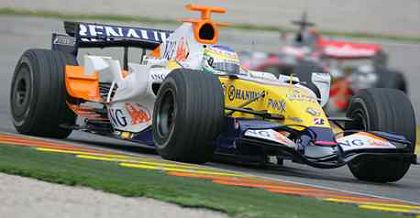
Renault R27
What else are we supposed to think when everything that McLaren said was discounted by the WMSC whereas Renault statements have been accepted without question, when McLaren were sentenced on grounds of suspicion while Renault have not been penalized in spite of there being proof of what McLaren were merely suspected of, when McLaren data were loaded on to the Renault computer system yet none of Coughlan's information found its way to the McLaren system? Quite clearly, the FIA wanted to penalize McLaren severely and exceeded their authority to do so, and did not want to punish Renault, bending over backwards to excuse anything found to have been wrong in their actions.
There is talk of the FIA losing credibility over the decision; but that is sheer nonsense. The FIA has had no credibility for years and has exercised blatant favoritism in its decisions without more than a murmur of discontent from the press. Although the penalties levied by the governing body have been unpredictable in the extreme, the actual decisions have been consistent to the point of utter predictability.
Our actions speak far more eloquently of our motivation than do our words. And the actions of the FIA, so often at variance with its public statements, are clear indicators of an organization working to an unspoken agenda of manipulation of the sport rather than fairness in application of the rules.
The plain fact is that the FIA, in deciding to go after McLaren, has gone so far beyond the bounds of reason and impartiality that an awkward precedent was set. If McLaren's penalty was justified (and it certainly was not), then at least the same must be applied to Renault, especially since Renault have been proved to have gone beyond anything that McLaren were accused of.
The similarities in the matters are quite striking. In McLaren's case, two drivers were proved to have discussed some of the Ferrari info and an engineer was shown a document that he took no interest in. Nine senior Renault engineers admitted to studying some of Mackereth's documents to the extent of deciding that they were of no use. The WMSC decided that the information "must have" penetrated McLaren as a result of the drivers' discussion but accepted that Renault gained no benefit from their study of the documents.
Much is also made of Renault's co-operation with the FIA and McLaren once senior management became aware of the situation; it does not seem to have been pointed out that this happened only after McLaren had run into problems thanks to its designer, Mike Coughlan. Does it occur to no-one that the real reason for Renault's sudden openness was that they realized that they too could be in deep trouble over a similar matter? McLaren were just as open when the facts about Coughlan's involvement became known but no credit was given to them as it was to Renault. Rather, it was implied that senior management at McLaren "must have" known what was going on or were incompetent for being unaware. Are we therefore to assume the same of Renault management - that they are either lying or incompetent?
Predictably, the FIA also turn to the method of information transfer as an excuse. It makes a big difference, apparently, if you gain your competitor's info from a migrating employee rather than one still ensconced within the company. Yet no account is taken of the fact that a few drawings are much more useful to an engineer than some details of when a car will make its pitstop during a race.
The point is really that the FIA has been forced to fudge the Renault issue because it could not afford to treat the company in the same way as it did McLaren. There are no surprises in the decision as it is exactly what we have come to expect of the governing body. When the only fair option entails the FIA admitting that it made a mistake in getting involved in the issues at all and rescinding its decision on McLaren, we can take it as read that it will take the low road and twist decisions to fit its own agenda.
The only question that remains is whether this will have some effect in the future or whether we can just mark it down as one more example of the FIA doing what it wants to do to suit itself. It has become a political organization, following the whims of its leader and then giving spurious explanations when things do not work out quite as planned.
Credibility? The FIA would have to care about motor sport before they could aspire to such a thing.
Renault R27
What else are we supposed to think when everything that McLaren said was discounted by the WMSC whereas Renault statements have been accepted without question, when McLaren were sentenced on grounds of suspicion while Renault have not been penalized in spite of there being proof of what McLaren were merely suspected of, when McLaren data were loaded on to the Renault computer system yet none of Coughlan's information found its way to the McLaren system? Quite clearly, the FIA wanted to penalize McLaren severely and exceeded their authority to do so, and did not want to punish Renault, bending over backwards to excuse anything found to have been wrong in their actions.
There is talk of the FIA losing credibility over the decision; but that is sheer nonsense. The FIA has had no credibility for years and has exercised blatant favoritism in its decisions without more than a murmur of discontent from the press. Although the penalties levied by the governing body have been unpredictable in the extreme, the actual decisions have been consistent to the point of utter predictability.
Our actions speak far more eloquently of our motivation than do our words. And the actions of the FIA, so often at variance with its public statements, are clear indicators of an organization working to an unspoken agenda of manipulation of the sport rather than fairness in application of the rules.
The plain fact is that the FIA, in deciding to go after McLaren, has gone so far beyond the bounds of reason and impartiality that an awkward precedent was set. If McLaren's penalty was justified (and it certainly was not), then at least the same must be applied to Renault, especially since Renault have been proved to have gone beyond anything that McLaren were accused of.
The similarities in the matters are quite striking. In McLaren's case, two drivers were proved to have discussed some of the Ferrari info and an engineer was shown a document that he took no interest in. Nine senior Renault engineers admitted to studying some of Mackereth's documents to the extent of deciding that they were of no use. The WMSC decided that the information "must have" penetrated McLaren as a result of the drivers' discussion but accepted that Renault gained no benefit from their study of the documents.
Much is also made of Renault's co-operation with the FIA and McLaren once senior management became aware of the situation; it does not seem to have been pointed out that this happened only after McLaren had run into problems thanks to its designer, Mike Coughlan. Does it occur to no-one that the real reason for Renault's sudden openness was that they realized that they too could be in deep trouble over a similar matter? McLaren were just as open when the facts about Coughlan's involvement became known but no credit was given to them as it was to Renault. Rather, it was implied that senior management at McLaren "must have" known what was going on or were incompetent for being unaware. Are we therefore to assume the same of Renault management - that they are either lying or incompetent?
Predictably, the FIA also turn to the method of information transfer as an excuse. It makes a big difference, apparently, if you gain your competitor's info from a migrating employee rather than one still ensconced within the company. Yet no account is taken of the fact that a few drawings are much more useful to an engineer than some details of when a car will make its pitstop during a race.
The point is really that the FIA has been forced to fudge the Renault issue because it could not afford to treat the company in the same way as it did McLaren. There are no surprises in the decision as it is exactly what we have come to expect of the governing body. When the only fair option entails the FIA admitting that it made a mistake in getting involved in the issues at all and rescinding its decision on McLaren, we can take it as read that it will take the low road and twist decisions to fit its own agenda.
The only question that remains is whether this will have some effect in the future or whether we can just mark it down as one more example of the FIA doing what it wants to do to suit itself. It has become a political organization, following the whims of its leader and then giving spurious explanations when things do not work out quite as planned.
Credibility? The FIA would have to care about motor sport before they could aspire to such a thing.