
Let me say right at the outset of this post that I have hated the idea of KERS in F1 from the moment it was announced. More than for any other of a multitude of reasons, I object to it because it enables the creation of a push-to-pass button (or push-not-to-be-passed button) which seems against the spirit of motor racing. It is like giving a long distance runner a skateboard and telling him that he can use it for 100 yards in every 500 of the race.
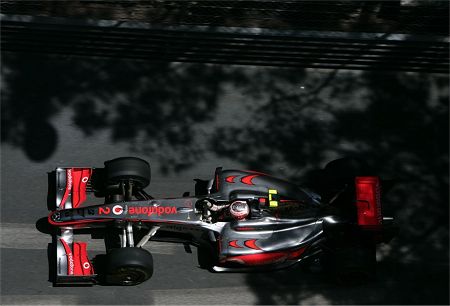
Heikki Kovalainen and the McLaren MP4-24
The argument against that view is that, once all the teams have a KERS system, true competition will be restored as every driver will have access to the magic boost button. This, of course, explains the rush for teams to build, beg or borrow a system as soon as possible; or it would, if there were any such rush taking place.
In fact, the only team that seems happy enough with KERS to have used it in every race so far this season is McLaren. Their system is clearly the best and the team is sure that it improves the performance of the MP4-24. Which should be no surprise since McLaren has long experience of the idea, having introduced it years ago, only to have it banned by Max Mosley. Other teams are obviously not sure that KERS gives any worthwhile benefit at all; their systems appear and disappear from one race to the next as they try to make up their minds.
As well as illustrating how dubious is the value of KERS in F1, the present situation also shows how our attitude to it has changed subtly as the season has progressed. Consider this statement from Mosley, made in March 2008:
This hybrid device [KERS] is set to revolutionise F1. It will make the sport at once more environmentally friendly, road relevant, and at the cutting edge of future automotive technology.
That is what we were first told about KERS, that it was a step towards the "greening" of F1. Yet today all that concerns us is whether it gives a performance advantage or not. Is that not a tacit admission that the technology is not environmentally friendly at all and that its only relevance for the sport is in its potential for giving a competitive edge? Even that debatable point in its favor will disappear when everyone has KERS, as we have already been told.
It has become abundantly clear that the introduction of KERS to F1 was a costly mistake that has not delivered on its promises. Whatever benefit it gives at the moment is a long way from justifying the amount of money spent on it and it will become increasingly out of place in the sport as the technology spreads. Has it "revolutionised" the sport? No, it has set F1 on a course of slow and expensive evolution along a path that leads nowhere.
Has it made the sport more environmentally friendly? Only if we ignore the extra fuel required to carry its weight around and the difficult problem of disposal of its expensive batteries. In fact, Mosley is so concerned with making his bad idea work that the weight limit has been raised for 2010 to make it easier for the teams to adjust the balance of their cars. More weight requires more fuel to maintain equal performance - or has Mosley somehow managed to alter the laws of physics?
Is KERS road relevant and is it at the cutting edge of future automotive technology? Maybe it is but that is not a matter that should be the concern of F1. I have no doubt that Max included this as a sop to the manufacturers currently supporting teams in the sport - the very same teams that he is now trying to force out of F1.
And, if the manufacturers leave, they will be replaced by small teams that do not have the budget to develop KERS systems. If KERS remains a part of the regulations or even becomes mandatory, such teams will have to buy in the systems from elsewhere. Which will force Max to introduce a standard system for all, thereby negating the whole idea of developing new technology.
We need to face the fact that KERS is an expensive and unnecessary distraction from the business and sport of F1. It may well be a useful interim technology for the car industry as it evolves towards a truly energy efficient future, but it has no sensible application in F1 at all. If the sport is serious in its desire to become more environmentally conscious, it has to consider dumping the dead end street that is gasoline/petroleum-fuelled technology and introducing cleaner fuels instead. I dislike agreeing with Richard Branson but he was right to suggest that the FIA consider his experiments with alternative fuels. Mosley's complete lack of interest is yet more proof that he is not guided by any genuine care for the conservation of this planet.
The sad fact is that F1 is still saddled with the curse of KERS because Max cannot bear to admit that he was wrong. Others may be prepared to ignore this elephant in the room but I will not. KERS has no place in the sport and should be outlawed at the end of the season.