
With the news that Super Aguri is having to decrease its staffing levels as a result of financial difficulties, my attention turns to the plight of the small team in F1. SA are walking a well-worn path in their money problems, repeating the inevitable pattern of restricted budgets preventing success and the lack of success rendering the team unattractive to potential sponsors.
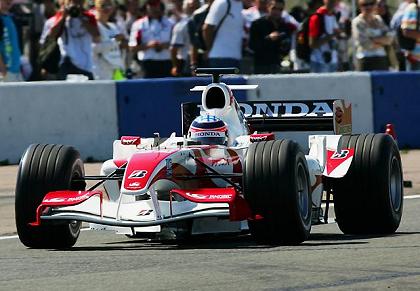
Super Aguri SA06
It is a downward spiral that is almost impossible to escape, even Minardi finally succumbing after twenty years of constant struggle. What makes Super Aguri different is its supposed status as Honda's 'B' team.
The reality is that, if this is Honda's attempt at a 'B' team, it's one done on the cheap. Red Bull take full responsibility for Toro Rosso, supplying it with funds through their advertising sponsorship of its cars; but not so Honda. The rumor that Honda paid for SA to use drivers it was interested in during the recent test in Barcelona, thereby dodging the testing limit, merely emphasizes the fact that Honda want to have their cake and eat it - they'll give money to the struggling team but only if it gives something in return.
That is hardly the relationship of an 'A' to a 'B' team. Super Aguri are in the unfortunate position of being labeled as a 'B' team without any of the benefits that should accrue from that.
The future looks grim for SA as a result; they have little to look forward to but more financial worries until they sell up to some hopeful concern wanting to enter F1 the easy way. And this is why the current argument regarding customer cars is so important for the future of the sport.
Prodrive have already confirmed that they will not be entering F1 in 2008, thanks to the customer car issue not being decided as yet. If the final decision goes against the customer teams, by strict application of the definition SA and STR should not be allowed to compete either. Which would leave only nine teams in the sport and eighteen cars on the grid. It seems a ridiculous situation to have shrinking entry lists when there are potential teams lining up to get involved.
Clearly, the problem needs to be addressed quickly and solved in such a way as to encourage the smaller team. And, quite frankly, that means allowing customer cars, whether Sir Frank Williams likes it or not.
All of the manufacturers that have the slightest interest in F1 are already involved (with one teetering on the edge of withdrawal as Renault await the results of their "spy" investigation); and only manufacturers can afford to enter the sport as fully fledged constructors, so high are the costs these days. SA, STR and Prodrive have demonstrated the only way remaining for small teams to get started.
The suggestion that customer teams be allowed to enter provided they agree to become constructors within a certain number of years is a possible solution. No doubt there are other compromises that could work too but the essential point is that, regardless of how it is achieved, it must be done and soon.
Bernie tried hard during the summer to get Spyker, SA and STR to agree to a compromise solution; ultimately, his attempt failed and now all hinges on the result of Spyker's arbitration case, something that should have been done and dusted at the beginning of this season, not the end.
After the WMSC hearing, Ron Dennis advised that McLaren would not be appealing against the decision because any further litigation would be bad for the image of the sport. Whether or not you believe that was the real reason, his statement does illustrate a factor that is ignored far too often in the disputes that seem so much a part of F1 in the modern world - that the health and survival of F1 is more important than any single team, that sometimes, for the sake of the sport, it is better to allow the option that is less favorable to oneself.
The parties that were too concerned with their own interests to reach a compromise solution when Bernie intervened should be thoroughly ashamed of themselves. They refused to be a part of the solution rather than the problem itself. One of them has already been forced to sell up to a new entrant and thus graphically illustrates how empty was the intransigence that refused to recognize the interests of the sport.
The message to those still trying to sort out the mess is clear: one way or another, customer cars must be allowed - reach agreement now or the sport suffers.
Super Aguri SA06
It is a downward spiral that is almost impossible to escape, even Minardi finally succumbing after twenty years of constant struggle. What makes Super Aguri different is its supposed status as Honda's 'B' team.
The reality is that, if this is Honda's attempt at a 'B' team, it's one done on the cheap. Red Bull take full responsibility for Toro Rosso, supplying it with funds through their advertising sponsorship of its cars; but not so Honda. The rumor that Honda paid for SA to use drivers it was interested in during the recent test in Barcelona, thereby dodging the testing limit, merely emphasizes the fact that Honda want to have their cake and eat it - they'll give money to the struggling team but only if it gives something in return.
That is hardly the relationship of an 'A' to a 'B' team. Super Aguri are in the unfortunate position of being labeled as a 'B' team without any of the benefits that should accrue from that.
The future looks grim for SA as a result; they have little to look forward to but more financial worries until they sell up to some hopeful concern wanting to enter F1 the easy way. And this is why the current argument regarding customer cars is so important for the future of the sport.
Prodrive have already confirmed that they will not be entering F1 in 2008, thanks to the customer car issue not being decided as yet. If the final decision goes against the customer teams, by strict application of the definition SA and STR should not be allowed to compete either. Which would leave only nine teams in the sport and eighteen cars on the grid. It seems a ridiculous situation to have shrinking entry lists when there are potential teams lining up to get involved.
Clearly, the problem needs to be addressed quickly and solved in such a way as to encourage the smaller team. And, quite frankly, that means allowing customer cars, whether Sir Frank Williams likes it or not.
All of the manufacturers that have the slightest interest in F1 are already involved (with one teetering on the edge of withdrawal as Renault await the results of their "spy" investigation); and only manufacturers can afford to enter the sport as fully fledged constructors, so high are the costs these days. SA, STR and Prodrive have demonstrated the only way remaining for small teams to get started.
The suggestion that customer teams be allowed to enter provided they agree to become constructors within a certain number of years is a possible solution. No doubt there are other compromises that could work too but the essential point is that, regardless of how it is achieved, it must be done and soon.
Bernie tried hard during the summer to get Spyker, SA and STR to agree to a compromise solution; ultimately, his attempt failed and now all hinges on the result of Spyker's arbitration case, something that should have been done and dusted at the beginning of this season, not the end.
After the WMSC hearing, Ron Dennis advised that McLaren would not be appealing against the decision because any further litigation would be bad for the image of the sport. Whether or not you believe that was the real reason, his statement does illustrate a factor that is ignored far too often in the disputes that seem so much a part of F1 in the modern world - that the health and survival of F1 is more important than any single team, that sometimes, for the sake of the sport, it is better to allow the option that is less favorable to oneself.
The parties that were too concerned with their own interests to reach a compromise solution when Bernie intervened should be thoroughly ashamed of themselves. They refused to be a part of the solution rather than the problem itself. One of them has already been forced to sell up to a new entrant and thus graphically illustrates how empty was the intransigence that refused to recognize the interests of the sport.
The message to those still trying to sort out the mess is clear: one way or another, customer cars must be allowed - reach agreement now or the sport suffers.