
Trying to be first with any news on Scott Speed's plans for the future has been quite interesting. To begin with, it confirmed my decision to position F1 Insight as an opinion blog, rather than a news site; one cannot compete with news services that receive preferential treatment from the original sources. Sure enough, the first I heard was from a Canadian newspaper site (of all places), closely followed by Planet-F1. I claim third place, however, which isn't bad, I guess.
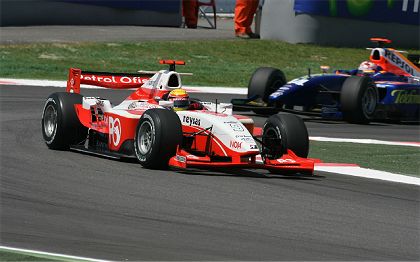
GP2 cars
That was yesterday. Today all the sites have the story, of course, but note that they are, with one exception, mere reprints of the first press release. At least I had the decency to use my own words and reflect on it a bit. The exception was Autosport that split the story into two, one for Speed and the other for Liuzzi, and added the text from Scott's own announcement on his website. I told you they were the best.
That will probably be my last adventure into the world of scoop journalism. It is much more fun to take the time to digest the news, put perhaps two stories together, and then pontificate on the whole thing.
Which brings me, strangely enough, to GP2. I managed to get up early enough before the Hungarian GP to catch the full GP2 race and, to be honest, I was seriously underwhelmed by it. If that is a fair example of the wonderful racing that everyone hammers on about, F1 has nothing to worry about. To me it looked amateurish, laden with silly mistakes, and the much-hyped Timo Glock was ordinary at best.
It may be that I watched the wrong race; the Hungaroring is a pretty poor place to go motor racing, after all. But I doubt it. I was not expecting lots of overtaking and exciting needle matches - I was watching in an attempt to spot the talent that everyone says is present in GP2. Instead I was treated to plenty of clumsy passing attempts and entirely unassisted departures from the track to go farming. There was little sign of real skill although, taking into account the fact that the cars are very closely matched, some drivers seemed a little faster than others.
I suspect that the problem is that the best drivers have already been taken up to F1. The "pinnacle of motor sport" had a bumper crop of rookies from GP2 this year and it may take time for more truly talented youngsters to make their way up from lower formulae to fill the gaps in GP2. And that may lead to the old F2/F3000 problem raising its head again.
There has always been difficulty in designing a formula as a feeder series for F1. It seems that every new attempt works for a year or two and then tends to fade quite badly until the FIA is forced to try something else. If GP2 is going through the same process, F1 team managers will soon be sifting through the ranks of F3 drivers in the search for new talent and GP2 will degenerate into a formula for the guys who did not quite make it and the ones who never will.
Bernie Ecclestone must be aware of this possibility for he is trying to encourage F1 teams to put more investment into GP2. But I think he may be embarking on a Canute-like quest against the tide in this. Talent is fairly obvious by the time it reaches F3 and team managers will always try to shortcut the process by grabbing the obvious future stars as soon as they appear. That may not be ideal for the development of the driver but F1 is a pitiless machine that soon spits out those who prove unable to adapt quickly enough. In these days of seemingly unlimited supplies of new talent, that can only become even more the case.
Another hope for GP2 is that it will enable teams to make the jump to F1. But this is a forlorn hope indeed. With F1 becoming a manufacturers' formula, it will become almost impossible for independents to push their way into the club. Historically, new teams tend to come from the same place as star drivers anyway: Formula 3.
I could be wrong about all this - it is all based on very little experience of GP2, after all. But it is hard not to see familiar patterns beginning to assert themselves and to imagine that we are going once more around the mulberry bush. Maybe the FIA should accept that any series introduced as a feeder to F1 will only work in that way occasionally and instead will become one for the nearly-men. Which is not the end of the world either; why shouldn't the nearly-men have somewhere to race too?
GP2 cars
That was yesterday. Today all the sites have the story, of course, but note that they are, with one exception, mere reprints of the first press release. At least I had the decency to use my own words and reflect on it a bit. The exception was Autosport that split the story into two, one for Speed and the other for Liuzzi, and added the text from Scott's own announcement on his website. I told you they were the best.
That will probably be my last adventure into the world of scoop journalism. It is much more fun to take the time to digest the news, put perhaps two stories together, and then pontificate on the whole thing.
Which brings me, strangely enough, to GP2. I managed to get up early enough before the Hungarian GP to catch the full GP2 race and, to be honest, I was seriously underwhelmed by it. If that is a fair example of the wonderful racing that everyone hammers on about, F1 has nothing to worry about. To me it looked amateurish, laden with silly mistakes, and the much-hyped Timo Glock was ordinary at best.
It may be that I watched the wrong race; the Hungaroring is a pretty poor place to go motor racing, after all. But I doubt it. I was not expecting lots of overtaking and exciting needle matches - I was watching in an attempt to spot the talent that everyone says is present in GP2. Instead I was treated to plenty of clumsy passing attempts and entirely unassisted departures from the track to go farming. There was little sign of real skill although, taking into account the fact that the cars are very closely matched, some drivers seemed a little faster than others.
I suspect that the problem is that the best drivers have already been taken up to F1. The "pinnacle of motor sport" had a bumper crop of rookies from GP2 this year and it may take time for more truly talented youngsters to make their way up from lower formulae to fill the gaps in GP2. And that may lead to the old F2/F3000 problem raising its head again.
There has always been difficulty in designing a formula as a feeder series for F1. It seems that every new attempt works for a year or two and then tends to fade quite badly until the FIA is forced to try something else. If GP2 is going through the same process, F1 team managers will soon be sifting through the ranks of F3 drivers in the search for new talent and GP2 will degenerate into a formula for the guys who did not quite make it and the ones who never will.
Bernie Ecclestone must be aware of this possibility for he is trying to encourage F1 teams to put more investment into GP2. But I think he may be embarking on a Canute-like quest against the tide in this. Talent is fairly obvious by the time it reaches F3 and team managers will always try to shortcut the process by grabbing the obvious future stars as soon as they appear. That may not be ideal for the development of the driver but F1 is a pitiless machine that soon spits out those who prove unable to adapt quickly enough. In these days of seemingly unlimited supplies of new talent, that can only become even more the case.
Another hope for GP2 is that it will enable teams to make the jump to F1. But this is a forlorn hope indeed. With F1 becoming a manufacturers' formula, it will become almost impossible for independents to push their way into the club. Historically, new teams tend to come from the same place as star drivers anyway: Formula 3.
I could be wrong about all this - it is all based on very little experience of GP2, after all. But it is hard not to see familiar patterns beginning to assert themselves and to imagine that we are going once more around the mulberry bush. Maybe the FIA should accept that any series introduced as a feeder to F1 will only work in that way occasionally and instead will become one for the nearly-men. Which is not the end of the world either; why shouldn't the nearly-men have somewhere to race too?