
In the comments section to Keith Collantine's article on the FIA's analysis of Ecclestone's medals proposal, this gloriously off-topic but accurate comment appears:
HounslowBusGarage says:
Keith,
I love the pic of the Brabham you selected for this article. Look at the elegant lines, the lack of complication in the design. It’s simple and superb. Not a blemish visible on the strict midnight blue and white colourscheme.
Normally, I’d select a JPS Lotus as the most elegant F1 car of all time, but this Parmalat Brabham comes close, very close.
I agree wholeheartedly, except that I consider the Brabham BT49 to be better than any Lotus ever produced. Nothing before or since has been so pure, elegant and satisfying to the eye as the BT49. In fact, Keith's photo does not show the car at its best; so effective was it that, for the first time in over ten years, the team was able to remove the front wing entirely for some races, thus demonstrating how completely the Brabham's designer, Gordon Murray, had mastered the art of ground effect. It also showed off the car's clean lines to greatest advantage.
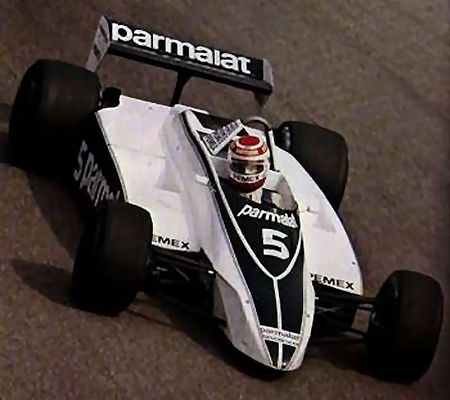
Nelson Piquet and the Brabham BT49
The year was the occasion of Nelson Piquet's first championship, 1981. One or two other teams were able to race without front wings that year, but none so often as the Brabham. That season was the result of two year's hard work for the team and the driver and their championship was deserved as no medal system would appreciate, judging by the FIA's analysis.
To my eye, the cars of that period, the ground effect era, are amongst the prettiest racing cars ever built and it is interesting to compare them to the designs for 2009. We see immediately how the new regulations have forced designs to return to a cleaner and less cluttered look but the wings seem to have gone mad in the meantime. In 1981 front wings were disappearing, now they are expanding into barn doors. And the rear wing has begun to shrink and tower above the car, whereas the '81 version was low, wide and flat. Such are the anomalies that occur when design is regulation-driven rather than inspired by innovation.
I know that we can never go back to skirts and ground effect again - with today's wind tunnels, the designers would build cars so impossibly quick around corners that the drivers would have to wear g-suits. But for those few years we were reminded that the ideal was to remove wings, that it might be possible that such ugly add-ons could be dispensed with entirely.
We are used to them now and those who have never seen F1 cars without them seem to think them essential, but wings are really just an interim arrangement, a temporary measure while the designers think of something better. They came close in 1981 and could do so again, if only we were to get away from the idea that everything must be regulated and that the real designers are the FIA rule makers.