
Anthony Davidson has obviously accepted that it is unlikely his employer, the Super Aguri team, will race again in 2008. Reacting angrily to David Coulthard's description of Davidson and Takuma Sato as the "Stupid Aguris", he pointed out that the SA car is virtually undrivable, making the task of keeping out of the way of lapping cars almost impossible.
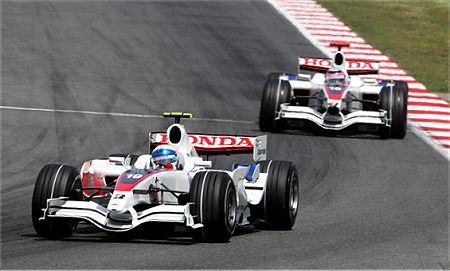
Anthony Davidson and Takuma Sato
It is rare for a driver to be so disparaging of the equipment he is given and this must surely indicate that Anthony knows it does not matter anymore. There comes a point where one has to face the fact that the dream has ended; Scott Speed reached it at the European GP last year and now it seems Davidson is there too.
That means there will be one less team on the grid for the remaining races in 2008. Although SA's problems are financial and began when a major sponsor reneged on payment last year, the team is indirectly a casualty of the decision not to allow customer teams to compete in F1. It is that ruling that has made it impossible for SA to find a buyer, the cost of upgrading the team to constructor status being sufficient to put off interested parties.
For the same reason, it is unlikely that Gerhard Berger will find an investor to share ownership of Scuderia Toro Rosso with him. The team is in a rather better position than SA, being still in possession of the old Minardi facilities, but development into full constructor status will be a costly process even so. That is why Dietrich Mateschitz wants to get rid of Red Bull's extra commitment, after all.
So the F1 grid could be down to eighteen cars by 2010 - this in a climate where new races are being added to the calendar and the upper limit of twenty GPs per year is being strained as Bernie Ecclestone tries to juggle the old with the new. All it will take is for a couple of the manufacturer teams to withdraw (and Renault is constantly on the point of doing so) and the sport will begin to look a very poor show indeed.
It seems obvious to me that the situation regarding customer cars needs more consideration. Compromise solutions have been suggested but not really looked at; the choice has always seemed all or nothing. Cost capping is regarded as a possible savior but will not begin to have an effect until the grid has been severely reduced. And the matter of costs is a relative thing anyway - it may seem a big improvement to existing teams to be spending $200 million in a year instead of $300 million but, to a team just setting up, both are likely to be out of reach.
Super Aguri is almost certainly lost to F1, STR may well follow it into oblivion. There is little time left to give STR some hope of survival and I believe that the FIA should be working night and day to achieve a way forward on this. It is not only about the continued participation of small teams - it is also about providing a route for new teams to enter the sport. As things are, only the big manufacturers can think of competing in F1 and there are few enough of those about, most being involved already anyway.
The agenda for any new FIA president must include this matter. The present incumbent was largely responsible for the recent Prodrive fiasco and for confused regulations that destroyed potential investors' faith in a practicable entry to the sport. The next must fix the problem very quickly or F1 will degenerate into a pointless affair forever dominated by one or two giants.