
Apparently, a rumor is doing the rounds in the F1 paddock that Ferrari have managed to increase the power available from their V8 engine for the 2008 season. The story goes that this has given them a decisive advantage over other teams.
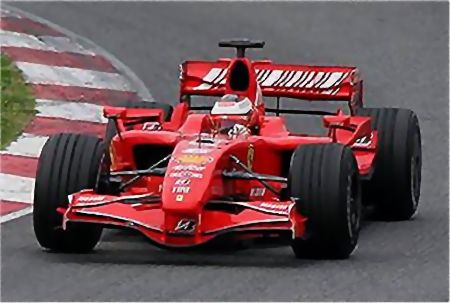
Being anti-Ferrari, naturally I seize upon this as an explanation for the red team's current dominance, stirring into the mix my suspicions that the FIA would assist in the process by allowing Ferrari tweaks that they would stop in others. But rumor is a dubious thing to base such theories upon and so I shelve the matter until more is known.
What I do find very interesting, however, is the fact that the engine freeze regulations contain such loopholes as allowing changes in the engines to solve reliability issues. We were led to believe that the engines were as good as sealed for the freeze and now it seems that is not quite the whole truth. If improvements are allowed on the grounds of reliability, it becomes a matter of opinion as to what changes are permitted and what are not.
This seems to be a recurring problem with far too many FIA regulations - too much hangs upon the way some faceless official interprets the case before him. Given that suspicion exists that Ferrari receive preferential treatment from the FIA, I would have thought that the organization should be doing its utmost to ensure that the regulations are clear, precise and beyond the influence of personal interpretation. Not so, it seems.
If the rumor has any factual basis at all, one would have to question there being any changes to the Ferrari engine approved at all on the pretext of solving reliability problems. In 2007, the engine was exceptionally reliable, on only one occasion (Kimi's retirement at the European GP for "mechanical reasons") where the cause might be said to be engine-related. The other two Ferrari retirements are put down to electrics (Kimi in Spain) and suspension (Massa in Italy). Such superb reliability hardly justifies any changes, particularly those that increase engine power.
Okay, it's a rumor only. But it highlights a potential trouble spot in the regulations and shows up the whole idea of an engine freeze as the silly idea it is. Of course one must make allowance for fixing problems that have arisen during competition - it would be unfair to expect a team to soldier on for the next few years with an engine that self-destructs in half the races. But the moment you allow changes to be made, costs increase (thereby negating the intent of the rule) and the possibility of cheating creeps in. There is nothing to stop the engineers continuing to work on the engine, searching for increases in power, and then claiming that a change is needed "for reliability reasons".
So the engine freeze becomes just one more of those debatable rules instituted by a governing body that has lost contact with reality. It has been obvious for years that the rules need to be simplified rather than made ever more complex and that new rules that do not work should be done away with. That would require the occasional admission from the officials that they were wrong and, unfortunately, they appear to be incapable of accepting their own fallibility.
I seem to be saying this a lot lately but it really is time that the whole incompetent bunch were thrown out and a new start made.