
Patrick Head said recently that it might be an idea for F1 to adopt reverse grids, with the fastest qualifiers at the back and the slowest car on pole. Max Mosley is said to favor a system whereby the drivers swap cars every race and so introduce a little spice into the equation. It is, perhaps, a measure of the desperation induced by the processional nature of many F1 races these days that such crazy solutions are suggested. The fact that there has even been some debate over them (all pointing out how silly the ideas are, fortunately) is a measure of the frustration amongst F1 fans in this area.
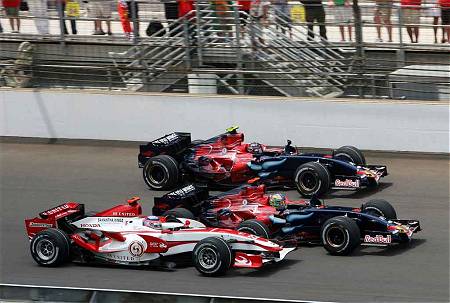
Should we be thinking of alternatives to the age old system of fastest gets pole? My answer to that is a resounding no, but I am always prepared to take into account my old foginess - I am open to being persuaded. It was one of Fernando Alonso's recent comments that raised a point that has bugged me for a long time and led on to thoughts on this business of the grid.
It was the unthinking acceptance that has greeted Alonso's statement that he always wants to be in the fastest car that got me going. Naturally, every driver wants the best car - it is a quick and easy route to winning races, after all. But, if we are concerned about the entertainment value of F1, it makes no sense to put the fastest drivers in the fastest cars. That is just ensuring that the race will be a procession.
Would it not make for better racing if we were to somehow ensure that the best drivers had the worst cars and vice versa? Sort of an unholy marriage between Head's and Mosley's ideas. We could rate the cars and drivers according to points scored in the previous season and then assign the drivers to teams accordingly. Kimi and Fernando in Force Indias, Hamilton and Kovalainen in Super Aguris, that would be fun. Button and Barrichello might find themselves in some pretty competitive machinery for a change, Sutil could at last get his hands on a McLaren and Fisichella might find himself back with his old friend Flavio.
Of course, for the first season, things would be a bit silly, as unregarded drivers suddenly proved that they had what it takes all along. But it might get Button the championship at last and the chaos would settle down in the second year.
Then there are the teams to consider. How encouraging it would be for some of the no-hopers to occasionally taste the delights of success thanks to having a demon driver one year. Spread the happiness, that's what I say.
Think of the strategic possibilities, too. As a team owner, do you go for the fastest design possible and hope that your duffer drivers manage to get to the front anyway? Or do you deliberately underperform to ensure you get the best driver next year? This is the kind of thing that Ross Brawn would thrive on - much more fun than trying to get the Honda team to work together.
It is a better idea than others that have been suggested, anyway. Reverse grids, for instance, have been tried in other formulae and work well enough if all you want to see is some overtaking; as a system of rewarding the most deserving, however, it is a non-starter. At least my suggestion would throw everything into complete turmoil and make predicting the champion virtually impossible.
But it is a lottery, much as the other solutions would be. As unfair as it is, the tried and tested method of fastest gets pole is the only one that works - if we want to preserve F1 as a serious form of motor sport, that is. The problem of processional races requires a good deal more thought than either Mr Head or Mr Mosley have given it so far, obviously. Let them go back to the drawing board and come up with something that has some concern for the sport this time.