
In the comments to my deliberately controversial previous post, it becomes clear that many set Hamilton's allegedly bad on-track behavior against the apparent inability of Massa to accept blame in any situation. Both viewpoints are debatable and I have had my say on Massa; now it might be opportune to turn the spotlight on Hamilton's misdemeanors, to see where his reputation for ruthless driving originates.
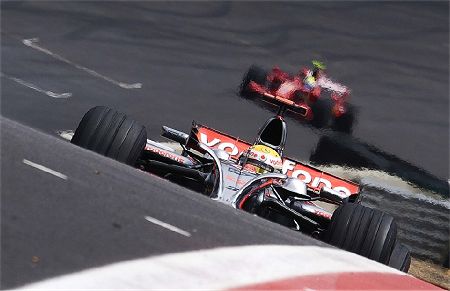
Lewis Hamilton
To begin with, I must point out that I see no evidence for the unsportsmanlike and overly robust driving that Lewis is so often accused of. This is not helped by the fact that most who hold that view will state their opinion without ever giving any details of why they have come to that conclusion, as though it were so obvious as to be beyond dispute. Most often, when any supporting evidence is provided, it is Monza 2008 that comes up and the incidents with Mark Webber and Timo Glock. Other than that, I see only vague references to Hamilton's on track antics, as though they were too numerous to need identifying.
So it seems that much of Lewis' reputation for robust driving stems from the two incidents at Monza and they are worth looking at closely, therefore. Unfortunately, Bernie has been at work and there are no videos on YouTube that show the events unfolding. I can only tell you what I saw and it will be up to you whether you agree or not (as it always is, I suppose).
Taking the Webber incident first, the two drivers are approaching the chicane at the end of the starting straight; Hamilton has the inside and is on the racing line (which is considerably further to the left as we view it - the rain has dictated that this line dries quicker and offers more grip). As Hamilton begins to decelerate for the corner, he also moves right (again, the drying line has dictated that this is the best approach to the chicane); Webber stays outside and begins to draw level.
This is the point at which versions differ. Some say Lewis forced Webber on to the grass but this is nonsense - Mark's tires do not leave the track until he enters the run off area for the chicane. Hamilton squeezes him, yes, but at all times leaves him room to stay on the circuit. Careful study of the video, if you have access to it, will reveal that Mark actually moves right to bang wheels with Lewis - and this is interpreted by the Hamilton haters as being an attempt by Lewis to shove the Australian off the track. Not so; Mark bounces off but not sufficiently to go off the track.
Then Lewis turns into the chicane and Webber, having overshot his braking point, has no option but to carry straight on and use the run off area. What Lewis did was no more than all F1 drivers do when challenged from the outside of the corner - they squeeze the guy to the edge but (if they are being fair) allow him enough room to stay on track. I see Hamilton's actions as well within the limits of decency as understood in modern F1 racing, therefore.
And so to Timo Glock, who so ironically was later in the year to be accused of allowing Hamilton through to claim a world championship. This time we are looking at the exit from the same chicane and Glock emerges from it immediately behind Hamilton. The Toyota proves to have better traction than the McLaren and Glock begins to ease up on the outside of Hamilton as they accelerate down the straight. Lewis moves over to close the door.
The (unwritten) rules say that a driver may block a following driver provided that he does so only once. What gets the Hamilton haters in a frenzy is that Glock goes on to the grass as a result of Hamilton's move - he has been forced there, apparently. But, in fact, it was Glock's choice; he was presented with two options: either lay off the accelerator or go on to the grass. He chose the latter.
The unwritten rules actually say that the driver in the lead may knock an overtaking driver off the track yet Hamilton did not make contact with the Toyota - he has been fairer than that. If we are to say that Glock did not have the option of easing off to avoid going off the track, how much more so is that true of Hamilton being forced to cut the chicane in Spa? And why are we not jumping up and down in rage at Raikkonen's identical squeezing of Massa on the first lap of the Belgian GP?
The answer is simple: it is Hamilton we are discussing here and we are looking for anything that can justify our criticism of him. It does not matter that we have seen other drivers get away with far worse - we need fuel for the anti-Hamilton fire and anything will serve.
I call the Webber incident as completely normal racing practice, the Glock incident I think was hard but fair by today's standards. But I also think that Hamilton's reputation stems from events much earlier than either of these events. It seems to me that it goes all the way back to last year, when the rookie Hamilton surprised us (and the other drivers) with overtaking moves that we had believed impossible. Time and again, it seemed that he could pass where no one else would dream of attempting such a move.
That is fine as long as such moves pay off; but they depend on luck to some extent at least and, when the luck runs out, they can look as idiotic as the successful ones seem inspired. And Lewis' luck began to run out this year - instead of working, many of his moves began to fail. That is partly because the other drivers became more aware and so more likely to shut the doors that had never seemed open until Hamilton came along.
But it matters not why luck turned against him this year. The fact is that, from being the wonder boy who could pass at will, he became as human as the other drivers and unlikely passing attempts became as risky as David Coulthard has demonstrated this season. In my view, Lewis has been the victim of his own initial success and has had to curb his more impetuous impulses increasingly as the year wore on. It may well be that the first corner incident in Fuji was the last optimistic move we have seen from Hamilton and that he will settle now into a rhythm of waiting for the best moment, rather than going impulsively for the first that presents itself.
That is a shame in a way, for it will make him far less spectacular than he has been at times. But, if it is championships that we demand of him, that is the way he has to go. He does not deserve the reputation for knocking off drivers that has accumulated around him but, equally, this season has taught him lessons about staying out of trouble that will have added to his racecraft immeasurably. The young Vettel, so often cited as the greatest danger to Hamilton's dominance in the future, will find that he has a mountain to climb if he is to live up to those expectations.