
In the wake of the voluntary budget cap for 2010 announced by the FIA, several changes to the regulations have been added and these are summarized in a useful Pitpass article today. As I have pointed out already and Keith Collantine mentions in a recent article in F1 Fanatic, these new regulations make the choice of an uncapped budget completely unworkable for a team that wants to win races.
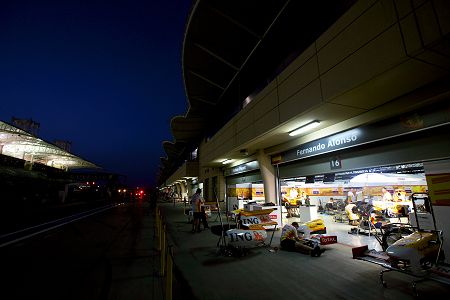
Renault pit garage at night
There are some changes made that, even taken alone, give the capped teams a winning advantage over those still subject to today's restrictions. The removal of the 18,000 rpm limit on engines immediately gives additional power that would probably be sufficient to overcome restricted cars; doubling the boost available through KERS adds yet further to this power advantage. Add the aerodynamic tweaks and unlimited testing permitted for the capped teams and there is just no contest.
So the manufacturer teams are not being presented with a viable alternative to the budget cap and we can forget all this talk of a two-tier formula. No team in its right mind is going to take the option of spending loads of money on a car that cannot compete with the unrestricted cars around it. The FIA may talk glibly about equality between the two options but it is talk only and cannot be achieved in practice.
The real problem is the figure decided upon for the cap; 40 million sterling may be enough for a small team to build a competitive car, as demonstrated by Williams and Force India, but it is expecting too much of the manufacturers to trim their budgets so drastically and so quickly. FOTA may be muttering about a two-tier system being unacceptable but what they really mean is that half of their members do not think they can get spending down sufficiently in so short a time period.
Inevitably, this will result in a war between FOTA and the FIA over the amount of the budget cap. Ferrari has already fired the first shot in the form of a letter to the FIA protesting the imposition without consultation and Max Mosley has answered with an equally belligerent response.
There are some fears that differing views amongst FOTA members may cause a split in the organization but I think the teams now recognize the need for a united front to be presented to the FIA. They have already achieved much and it would be against everyone's interests to be entirely selfish in their attitude to the new regulations. Just as the big teams do not relish the expense and complication of setting up a rival series, the smaller teams must know that a championship without Ferrari and McLaren would be devalued to the point of worthlessness.
It seems to me, therefore, that FOTA must thrash out a reasonable figure for a budget cap acceptable to all its members and then present its proposal to the FIA. Judging by Mosley's previous tactics in such matters, this is pretty much what he is angling for and agreement will be reached in the end - provided that FOTA remains united, of course.
The fly in the ointment remains Bernie Ecclestone and his CVC employers. While the FIA and FOTA establish battle lines, Bernie has escalated the war over payments and is now threatening to withold money due to the teams unless they commit to a new Concorde Agreement. It seems that the talk of F1 teams actually making a profit through the budget cap is a bit premature and they may have to accept whatever they can get from the paymasters of the sport.
Meanwhile the actual racing continues to enthrall millions around the world. F1 is still a hugely popular sport in spite of the almost continual political fights and we must hope that, in their struggles, the various powers do not destroy the goose that laid the golden egg. As they jostle for power and money, it is easy for them to lose sight of the point of it all, the survival of F1 as the pinnacle of motor sport. Let us hope that the best interests of F1 will be served in the end and that we can look forward to many more years of excellence in competition as a result.