
Now that Bernie has declared that there will definitely be night races in F1, it seems the FIA are getting down to the task of assessing the viability of such races. Autosport reports that a test has been conducted at the Indianapolis circuit to decide whether drivers can see well enough at speed under floodlit conditions. Apparently, the FIA safety car and some medical cars tackled a few corners "backwards and forwards" for half an hour.
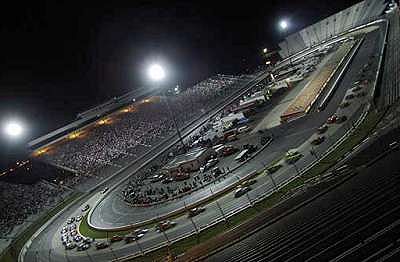
Apart from the mystery implicit in that backwards/forwards statement (What, they reversed? Or did they lap the circuit in both directions?), I find that the names Heath Robinson and Rube Goldberg keep occurring to me. It seems a bit late to start testing after a firm commitment to night races has been made. And how relevant is a test conducted by saloon cars (presumably with their lights turned off) in a stadium supplied with floodlights?
I suppose that the idea is to start slowly and build up to actual F1 racing speeds but when one considers that the first night GP will be held on a street circuit, perhaps in the rain, it seems pointless to prove that drivers of road cars in very different circumstances don't have a problem with vision at night. At least they could have thrown some water on the track to see how confusing reflections can be.
Perhaps the whole thing is a public relations exercise and we are intended to draw the conclusion that, if the safety car can zip through a few corners under floodlights at Indy, the likes of Alonso and Raikkonen should easily master Melbourne streets on a rainy night. Somehow, for me, that doesn't wash.
There used to be a convention that, before allowing a GP to be held on a new track, one of the lesser formulae would stage a race there; it made sense that any problems would be uncovered by slightly slower cars before the technical masterpieces of F1 were unleashed upon the circuit. But in the brave new world of 21st Century F1, Bernie's whim is law and what he says will happen, will be so.
Give the drivers their due: most of them are not averse to the idea of night races, provided that safety is not compromised. That is an important proviso, however, especially if the FIA is going to present its Indy test as proof that the idea is workable. I would think that the drivers would require a good deal more assurance than that before being satisfied that night GPs are safe.
The problem for the FIA is that the proposed night races are to be held on street circuits. They cannot be tested beforehand without the city agreeing to shut down for tests to be held. And that means more expense, more problems for the organizers, more disruption for the city. The whole idea begins to look like more trouble than it is worth.
Let us remember that the only reason Bernie came up with the idea was to be able to televise the races at a time more convenient for European audiences. Aside from the fact that the true F1 enthusiast does not mind getting up in the early hours to feed his habit (and it adds a certain spice to the experience, let's be frank), does not this bring into question the FIA's determination to spread GPs across the globe, robbing Europe of time-honored races at the same time? To me, it looks like an admission that the vast majority of F1's audience still resides in its core arena, Europe.
We want the rest of the world to share in the enjoyment of F1; if it is to be truly a world championship sport, this is entirely necessary. But Bernie should be thinking about how Australian and Asian audiences will feel when they are expected to attend at all hours of the night purely for the benefit of the European viewers. If night races are an absolute must, let the first be held on a boring European circuit like Barcelona where it might just add a bit of spice and the safety facilities are tried and tested. We'll stay up for it, Bernie, I promise...
Apart from the mystery implicit in that backwards/forwards statement (What, they reversed? Or did they lap the circuit in both directions?), I find that the names Heath Robinson and Rube Goldberg keep occurring to me. It seems a bit late to start testing after a firm commitment to night races has been made. And how relevant is a test conducted by saloon cars (presumably with their lights turned off) in a stadium supplied with floodlights?
I suppose that the idea is to start slowly and build up to actual F1 racing speeds but when one considers that the first night GP will be held on a street circuit, perhaps in the rain, it seems pointless to prove that drivers of road cars in very different circumstances don't have a problem with vision at night. At least they could have thrown some water on the track to see how confusing reflections can be.
Perhaps the whole thing is a public relations exercise and we are intended to draw the conclusion that, if the safety car can zip through a few corners under floodlights at Indy, the likes of Alonso and Raikkonen should easily master Melbourne streets on a rainy night. Somehow, for me, that doesn't wash.
There used to be a convention that, before allowing a GP to be held on a new track, one of the lesser formulae would stage a race there; it made sense that any problems would be uncovered by slightly slower cars before the technical masterpieces of F1 were unleashed upon the circuit. But in the brave new world of 21st Century F1, Bernie's whim is law and what he says will happen, will be so.
Give the drivers their due: most of them are not averse to the idea of night races, provided that safety is not compromised. That is an important proviso, however, especially if the FIA is going to present its Indy test as proof that the idea is workable. I would think that the drivers would require a good deal more assurance than that before being satisfied that night GPs are safe.
The problem for the FIA is that the proposed night races are to be held on street circuits. They cannot be tested beforehand without the city agreeing to shut down for tests to be held. And that means more expense, more problems for the organizers, more disruption for the city. The whole idea begins to look like more trouble than it is worth.
Let us remember that the only reason Bernie came up with the idea was to be able to televise the races at a time more convenient for European audiences. Aside from the fact that the true F1 enthusiast does not mind getting up in the early hours to feed his habit (and it adds a certain spice to the experience, let's be frank), does not this bring into question the FIA's determination to spread GPs across the globe, robbing Europe of time-honored races at the same time? To me, it looks like an admission that the vast majority of F1's audience still resides in its core arena, Europe.
We want the rest of the world to share in the enjoyment of F1; if it is to be truly a world championship sport, this is entirely necessary. But Bernie should be thinking about how Australian and Asian audiences will feel when they are expected to attend at all hours of the night purely for the benefit of the European viewers. If night races are an absolute must, let the first be held on a boring European circuit like Barcelona where it might just add a bit of spice and the safety facilities are tried and tested. We'll stay up for it, Bernie, I promise...