
Now that the dust has settled, the grid been decided and then altered with the Toyotas and Hamilton sent to the back, and the Williams protest against Ferrari and Red Bull been withdrawn, we can begin to take a long view of qualifying to see if there are some answers to the questions of the off season. And the first imponderable is that the Brawn GP car really is as good as it promised to be.
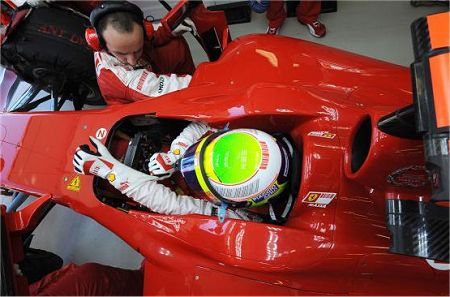
Felipe Massa gets ready
Throughout qualifying, Button and Barrichello were in a league of their own, battling each other out front. The fact that cars without the double-decker diffuser came close to them shows that it is not just the extra downforce at the rear that is making the difference - the Brawn is good in other areas too and will probably remain competitive even if the team is ultimately forced to run with a conventional diffuser.
As has been said many times, that has to be at least partly thanks to the long preparation the team has put into the car and that is confirmed by the BMW (minus KERS and a fancy diffuser) being a strong contender as well, the team having worked on their 2009 challenger almost as long as did Honda. But it is not the whole story. Brawn GP has managed to produce the best car in spite of very limited testing - and we have seen in the Hondas of previous years and the MP4-24 McLaren how the computers and wind tunnels can get it very wrong.
It looks as though the difference is Ross Brawn himself. His record of creating winners from failing teams continues and this is surely proof that his value to Ferrari was much more than just tactical genius in the races. Perhaps they are regretting now that they could not find room for him after his sabbatical...
Another thing that screams at me from the qualifying sessions is that KERS has proved itself more of a hindrance than a benefit. Having more ballast with which to fine tune the handling of a car is clearly more important than a six-second boost of power on the straights - just ask Nick Heidfeld, who narrowly missed getting into Q3 while his KERS-less team mate wound up fourth quickest.
But it was not just the Beemers that showed how pointless is KERS; the Ferraris and McLarens, both running KERS, would have been grateful for a little more ballast to offset the advantage of the double-diffuser boys. I am not saying that KERS was the cause of McLaren's problems but it certainly complicated the matter of improving the car's handling.
It would not surprise me if the teams currently running KERS were to quietly dump it for the next few races or even the whole season. Were testing still permitted, they could work on finding a decent balance with KERS fitted but that possibility has now gone. The easiest solution is to get rid of it.
I sympathize with those who prefer to see fuel strategies unfold during the race but the publication of the weights of the cars does reveal a lot that we can talk about. As an instance, we can see that Kubica set his Q3 time with the lowest fuel load of all, whereas Heidfeld has been topped up to be the second heaviest. Robert will be the hare, it seems, while Nick must defend his position (now elevated by the Toyota penalty) until the pit stops hand him an advantage.
It is apparent, too, that the Brawns were not light on fuel and so we have more confirmation of how good the car is. The Ferraris are a bit light, which might give Mark Webber (immediately behind them on the grid) two or three extra laps to get by during the pit stops. Nakajima has gone for a strategy similar to Heidfeld's whereas Hamilton is light, obviously hoping to be quick enough in the early laps to pick up a few places. It will be interesting to see how the various strategies pan out on Sunday.
Finally, I want to look at something pointed out by Hezla in the comments to my previous post - BMW's apparently overconfident policy of holding their drivers in the pits until quite late in each qualifying session. The strategy ruined several of Heidfeld's qualifying chances last year in that it gave him no leeway to make up for even a slightly-botched lap and one has to wonder at the philosophy behind it.
This year it seems sheer madness. The ban on testing during the season means that the teams have to use every minute of practice to try new tweaks and this squeezes the time available for setting up the cars. Naturally, this means that there is still fine tuning to be done in qualifying and precious little time to do it in. Surely the best policy would be to set a banker time early in each session and then attend to any handling issues that crop up.
I could be wrong on this one - after all, Dr Mario must know what he is doing. But it leaves me in an agony of frustration in every qualifying period, begging the Beemers to come out while they sit, apparently twiddling their thumbs, in the pits.
Ah well, I suppose that is the disadvantage of having a favorite team...