
I see that NASCAR has had a problem at Indianapolis with tires wearing out after only six laps of the oval circuit. This was solved by having caution periods every 12 laps in the race but it does bring back memories of the 2005 F1 GP at Indy. Michelin found that the tire they had brought was failing on the banked corner with the ultimate result that only the Bridgestone runners, six cars, took part in the GP.
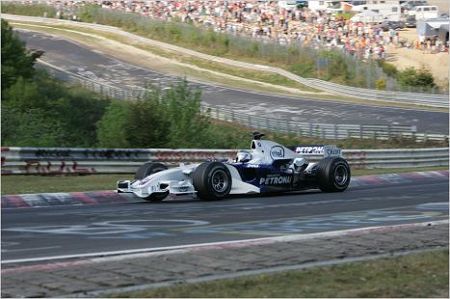
Nick Heidfeld on the Nordschleife
In a discussion that developed on a Sidepodcast blog post, it was suggested that the diamond cut surface was partly to blame for the problem:
part of the problems in ‘05 were related to the diamond cut surface. who thought that would be a good idea? it wrecked tyres in a test prior to the f1 race and then it did the same when the teams arrived. now it’s doing it to nascar rubber.
I do not know how true this is, but it does illustrate a point I have been thinking about for some time. The fact is that modern racing circuits are designed to accommodate the cars being used at the time; which seems reasonable until we look at the cost of creating circuits for F1 - something that has suddenly become very relevant for the owners of Donington Park in their quest to stage the British GP in 2010. Amounts over $100 million are bandied about as being required merely to get an existing circuit up to F1 standards.
Are we not approaching some sort of financial limit on the amount that can be achieved by circuit design? And is it sensible to allow the limitations of the cars to dictate the parameters of the circuits? For a start, let us consider the surface needed to accommodate a modern F1 car; it must be as devoid of bumps and irregularities as is possible, approaching billiard table smoothness, in fact. And still the drivers will talk of "the bump at corner X" - naturally so, since suspension travel on the cars is almost non-existent and ground clearance minimal.
The requirements of aerodynamics and ground effect have insisted upon cars that run as close to the ground as possible but, with the track surfaces as smooth as they are, there is no counterforce giving a practical balance to car design. We dream of a return to the Nordschleife at Nurburg but it can never be, not only for safety reasons, but also because there are parts of the track where a modern F1 car could not run. When Nick Heidfeld took the BMW F1 car for a couple of laps of the Nordschleife recently, he was instructed not to run on the banking at the Karousel and to keep his speed down at other points. Even thoughts of a return to Long Beach are pie in the sky unless the bumps and jumps were evened out.
Grand Prix racing began on existing roads and the cars had to be designed to cope with whatever was thrown at them. This was the opposite extreme to the situation today but it did at least ensure that designers had to take into account the conditions the cars would encounter. They were practical machines that you could drive home after the race.
This continued until the seventies, when the arrival of wings and, later, ground effect, began to insist on the cars having a reasonably smooth surface to run on. Circuits moved with the times or were abandoned accordingly and the FIA began to stipulate parameters for circuit design. With each advance in the circuits, the cars took more advantage on the aerodynamic front and now we have a situation where we have to limit all sorts of aspects of the cars to prevent them becoming impossibly fast.
It may be that it is time to turn the clock back a bit and allow circuits to be a bit more primitive. With street circuits multiplying, this is an ideal chance to do just that. Never mind the FIA inspections to ensure that everything is within stated limits - let the cars cope with the irregularities of city streets just as they are.
I am not proposing that we introduce artificial bumps on existing circuits. There is no need to do that since the presence on the calendar of two or three "rough" circuits would dictate that the cars be designed to cope. And the result would be more suspension travel, more ground clearance and less downforce. There would have to be a return to mechanical grip, something we have been wanting for a long time.
The FIA is trying to reduce downforce drastically with the rule changes due to take effect next year. Much of what they are doing involves complex measurements and systems to ensure that the rules are complied with (the adjustable wings are going to be a major headache to police), yet the regulations are already so complicated that they give rise to endless debates and argument.
Surely the aim should be simplification rather than regulation of every tiny facet of design? And, as part of that equation, we should be thinking about freeing up circuit design as well, it being another way in which the engineers can be forced to live in the real world.