
There used to be an understanding that the early "away" races of an F1 season were bad pointers to form for the season. Often, it was said of the first GPs in Europe that "the season starts here" - and there was a lot of truth in that. It is not so clear cut these days, even though the teams tend to look forward to Barcelona as their opportunity to improve upon any poor results thus far. Since all the teams are beavering away at tweaks to make their cars more competitive, relative form tends to remain much the same as everyone increases the pace of development.
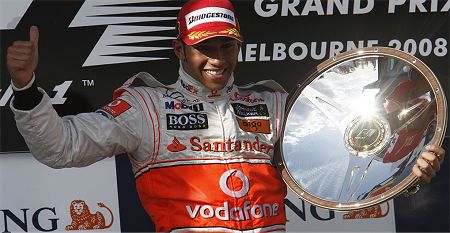
Lewis Hamilton in Melbourne
There is even a case for saying that the first race of the year provides the clue to the drivers' championship. Last year, Kimi Raikkonen won in Melbourne and, despite a very inconsistent season and a strong challenge from his team mate, he came through at the last to be champion. In 2006, Fernando Alonso won the first race, the Bahrain GP, going on from there to his second championship. The fact that Bahrain was the beginning of the season that year might have weakened our theory - except that Fernando did us the favor of winning in Melbourne too. So maybe it is the Australian GP that indicates the future champion.
When we go back as far as 2005, however, things begin to break down; Giancarlo Fisichella threw a spanner in the works by winning his only race of the year in Melbourne. But at least he was driving the car that was to win the constructors' title, the Renault R25. So perhaps our theory applies more to the constructor than the driver.
In fact, we have to go back as far as 2003 before we run into an Australian GP where the winner did not go on to help his team win the constructors' championship - David Coulthard was the man who messed us up on that occasion. Four years of success in predicting the winning team is not a bad record, however, especially when we recall that this may be a new trend, overcoming the old adage that the season starts in Europe.
If we place any faith in the theory, it would mean that McLaren will be champion this year. On form since Melbourne, that looks a rather hazardous bet - most pundits are going for Ferrari as winners again. But it will be an interesting test of our theory - if McLaren do win in the end, the Australian GP strengthens its claim to be the one indicator that cuts through all the changes in fortune throughout the year.
Turning back to the coming weekend's GP in Barcelona, it is expected that true form will emerge at last and we will have a better idea of how the season will pan out. Yet that is a debatable point as well; in 2007 Ferrari won in Spain with Massa aboard but the next three races were taken by McLaren. Without the constant interference of the FIA, it is quite likely that McLaren would have won the championship too.
That last is a red herring that I could not resist, of course. If any theory is to gain credence, it must function despite any outside factors; we are only interested in pointers towards reality, not what might have been. And the Australian GP theory is as good as any at the moment. If you fancy a flutter on the final outcome of the constructors' championship, you would do well to include the Oz Theory in your calculations.
Not being a betting man, this matter of predicting winners is merely interesting to me and I take no notice of history and statistics when guessing future champions. That is much more of a discussion between the heart and the head, with a little intuition thrown in, perhaps. The Oz Theory is a fragile quirk, after all, and it becomes more so with each year that it holds good. The likelihood of an upset must always increase as the years pass.
I just hope I'm not still saying this after another ten years...