
With Takuma Sato's departure with Super Aguri from the F1 grid, Kazuki Nakajima becomes the sole Japanese representative amongst current F1 race drivers. This has been generally the case with Japanese drivers, their presence limited to one and sometimes two since Kazuki's father, Satoru Nakajima, made his debut in 1987. This steady and continuing presence is actually unusual in F1, only the United Kingdom, Italy and Brazil having at least one representative in any given period.
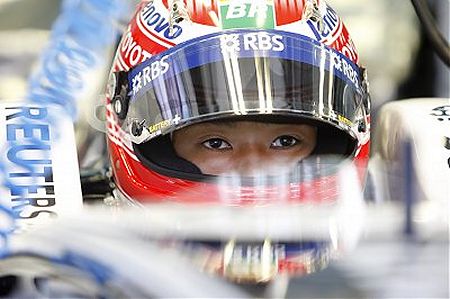
Rising son, Kazuki Nakajima
Formula One began with Italian domination in both cars and drivers but, since the fifties, their driving presence has settled into a pattern similar to the UK's - almost always there but never outnumbering the rest. Other countries have experienced wild fluctuations in numbers of F1 drivers, rapid invasions being followed by a tailing off, sometimes to complete absence.
The first great influx of a single nationality occurred during the seventies and into the eighties, when French drivers became a must-have, this explosion being caused almost entirely by the Elf Young Drivers Scheme. Great names from this period include Jean-Pierre Jarier, Patrick Tambay, Didier Pironi, Alain Prost, Rene Arnoux and Olivier Panis.
As the Elf Scheme was cut back, this supply of young drivers waned and Sebastien Bourdais is the sole Frenchman on this year's grid. Spain is presently enjoying a moment in the sun, thanks to the amazing talent that is Fernando Alonso, but the quality of potential replacements seems to be lacking somewhat. Instead, there has been a steady increase in the number of German F1 drivers, sparked, no doubt, by the phenomenal success of Michael Schumacher. This year we have five Germans with race seats, Nick Heidfeld, Nico Rosberg, Timo Glock, Sebastian Vettel and Adrian Sutil. Add the Williams test driver, Nico Hulkenberg, and this amounts to an invasion.
It is not one that is likely to last long, however. With Michael retired, the onus is on the present drivers to prove their worth and, to date, only Heidfeld and Rosberg are delivering. Reality sets in as Glock, Vettel and Sutil struggle to assert themselves and the future may well look elsewhere for its world champions.
So where are those future stars likely to come from? Interestingly, it might be that India begins to supply a steady stream of gifted youngsters, although this will take time and will be dependent upon the success of the Force India team. If Vijay Mallya's plans bear fruit, his search for young Indian drivers in karting will produce a flood of new talent into the sport.
I used to think that there would come a time when F1 would be dominated by Japanese drivers but the inability of Japanese teams to make a big impact on the sport must decrease this chance. If either Honda or Toyota drop out of F1, opportunities for new Japanese drivers will shrink accordingly. Much rests on the shoulders of Kazuki Nakajima as a result.
Kamui Kobayashi and Sakon Yamamoto wait in the wings but do not seem to be brilliant prospects and other possibilities are not making themselves known. Young Kazuki must prove to the world, therefore, that Japanese drivers can be more than highly entertaining accidents looking for a place to happen. The signs are good that he might just manage this.
Other countries tend to provide occasional drivers, Argentina, Colombia, Mexico, the Netherlands, Sweden and others having made their contributions. Finland appears to be bidding for a regular spot but its population is probably too small to ever supply the quantity that France has achieved. They did manage to dominate rallying in the sixties and seventies, however, so cannot be completely ruled out.
It would be nice if Robert Kubica could become champion one day, however. As the solitary Pole on the grid, he would be striking a blow for the new countries to F1, places like Estonia (Marko Asmer) and Russia (Vitaly Petrov). As F1 extends its popularity to become more international than ever, the likelihood is that an increasing number of drivers will appear from countries that have never featured before. And that is how it should be.