
I am not convinced that penalties should take effect in the race following the one in which the offense was committed. It strikes me that this has two undesirable effects - that the second race is unnaturally affected by a driver striving to lessen the effect of his penalty and that the system is open to abuse for the purpose of race fixing.
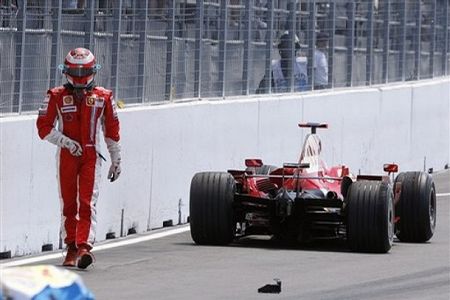
Kimi Raikkonen in Montreal 2008
The fact that a driver dropped ten places down the grid will have to fight his way back up the field is often suggested as a benefit to these delayed penalties, thereby giving more entertainment value to the fans. But it is an artificial injection of excitement, similar to the idea of reversed grids, and would no longer be valid if overtaking were not so difficult as at present. There is also the variable nature of such penalties, sometimes resulting in none at all if the driver is able to force his way to the front in spite of a grid penalty.
As we have seen recently with Hamilton's ten-spot penalty in France, the effect on the penalized driver can be to induce a feeling of having nothing to lose, encouraging dangerous overtaking moves and increasing the risk of accidents. This spreads the possible effects of the penalty to other drivers, since they could be taken out of the race by a badly-timed move by a driver coming through the pack. If we are so concerned about safety, why penalize in a way that increases the risk to drivers who were not involved in the original offense?
I suspect that these grid penalties have become so popular because they are an easy way to shuffle the grid and so disguise the fact that modern F1 has so few passing maneuvers. Has the show become so all-important that it is necessary to hide the processional nature of races brought on by restrictive rules and modern circuit design? Surely the governing body should be doing all it can to tackle the problem at its roots, rather than attempt cosmetic solutions such as delayed grid penalties?
And that brings me to the matter of race fixing. The most blatant example of the FIA trying to keep a championship alive was the 2006 ban on mass dampers, obviously designed to prevent Renault and Alonso from running away with the titles. But there have been other instances where it has looked as though sudden rule changes were introduced with the intention of affecting the championship. The spread of delayed grid penalties only increases the opportunities for officials to meddle with what is happening on the track; they need only await their opportunity to hobble anyone performing too well.
It seems to me that penalties should fit the offense and should not be open to change by performance in the following race, whether spectacular or disastrous. If a driver has done wrong, he should be dealt with promptly and fairly, without the possibility of escaping altogether. The FIA does fine drivers on occasion but this, too, is not ideal, since their earning capacity varies so much. Perhaps the fairest way would be to dock points from those already scored, although this means that drivers who have scored no points effectively escape punishment. This matters less once we take into account the fact that such drivers are usually at the back of the grid and grid penalties become meaningless for them anyway.
Of course, a system involving points deduction is open to abuse too but it would be more obvious if applied clumsily - and the FIA are not noted for their subtlety in such things. More importantly, it would enable penalties to be set out in advance so that everyone would know just how much each offense would cost. And we would avoid this business of races being affected by the previous race, something that strikes me as being unfair and unnatural. Let each race start with a fresh slate for everyone - that seems to me the way to go.