
Amongst the news emanating from today's testing at Barcelona was a report that Williams had temporarily halted their test while they traced the cause of an accident suffered by Kazuki Nakajima. The driver was unhurt but the crash appeared to be the result of mechanical failure. It was later confirmed that there was a front wing mounting issue that would be solved in time for the car to be run in testing tomorrow.
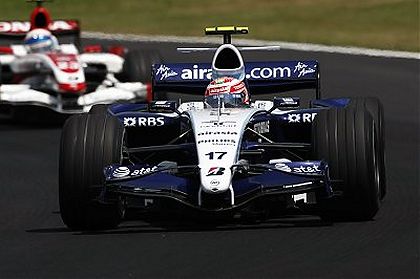
Kazuki Nakajima
This is a timely reminder that the possibility of mechanical failure remains in F1. With the engines becoming so reliable, we have been lulled into thinking that F1 cars do not break anymore, whereas they can and sometimes do. And this poses a question over the latest safety measure that has been so well received to date: the replacement of gravel traps with asphalt run-off areas.
Apparently, Nakajima's car went straight on at turn 1 and did not slow down over the run-off area before hitting the barriers. That speaks immediately of something having broken and so prevented the driver from braking effectively; but it also makes me wonder about the wisdom of paved extensions to the tracks.
I have written before about the grey area created by the new run-offs but that was in connection with their usefulness in gaining an advantage in the race. Nakajima's crash brings to mind the memory of another Williams going straight off the track at a fast corner and heading, speed unabated, for a concrete wall - at Imola in 1994.
Senna's fatal accident happened at a point where there was only grass between the circuit and the barrier; a gravel trap might have slowed the car sufficiently to lessen the impact considerably. The loss of grip on a grassed surface would have made the brakes almost useless and so it was possibly the worst type of surface to have at that point.
The argument against gravel traps has been that modern F1 cars tend to skate across their surfaces, thanks to their flat bottoms; the wheels do not dig in and so no deceleration benefit is received. But I am not convinced that paving the run-off area is the ideal solution. As long as the driver retains some control, yes, they appear to be the answer. But, when brake or wing failure is the cause of the car running off the circuit in the first place, the run-off becomes a fast exit route to the nearest barrier.
I am not arguing against the paved run-off areas. It just seems to me that they are not the perfect solution that we thought they were. There are circumstances in which they can add to the severity of a crash, rather than cushion it. Taking this into account with the possibility of unfair advantage being taken of them to gain or keep position in the race, it looks as if we have some more thinking to do before reaching the best possible compromise in this area.
It is good news that Nakajima was unharmed in the incident. Apart from anything else, I am hoping for great things from him this season. The FW30 is very promising and Kazuki, as well as Rosberg, has been getting some excellent times from it. But let us hope that never again do we have to hear of a Williams going straight on at a corner...