
There are times when F1 watchers are double-minded. On the one hand, everyone waits with bated breath to see whose car Alonso will be driving in 2008, showing that we still believe that the driver can make a big difference. But on the other, we downplay Hamilton's performance in his first season by saying that any rookie would have done the same with such excellent equipment, in effect meaning that it's the car, not the driver, that wins races.
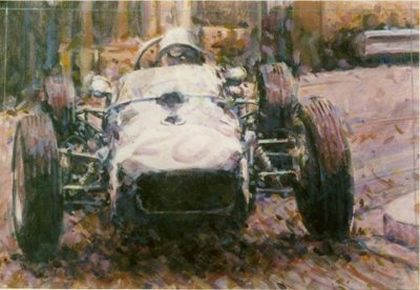
The man who could - Sterling Moss, Monaco, 1961
Image courtesy of Rob Ijbema
The truth is that it's a mixture of both, of course, just as it has always been. And so there is some truth in the belief that a driver like Alonso will bring an extra measure of speed to a team but, if you put him in a Spyker, for instance, he would do little better than Sutil managed this year. And, no matter how good the car, a second rate driver will never win races in it - stand up Hector Rebaque, Alex Yoong and any number of other examples over the years.
This has to be a sign that there is life in F1 yet. We may lament the fact that the rules have decreased the driver's importance to almost microscopic dimensions, but there is no doubt that he remains a factor in the formula for success. As the regulations turn once again to limiting the use of electronic aids in the sport, the hope is that the balance will be restored and winning races will become at least a little less dependent on the name of the car being driven.
Much faith is vested in the ban on traction control in this quest to return the driver to his former status as a major component of success. Just as the switch to Bridgestone tires gave some drivers more problems than others this year, the lack of TC could favor those who are able to adjust their style quickly. Putting it in perspective, however, this change is a very minor part of all that needs to be done to balance the contributions of driver and car again. Not until aerodynamics is severely limited will we return to the days when a driver could overcome deficiencies in the car to the extent of winning races.
But at least we seem to be on the right track again. News of the possible return of slick tires is another step forward (or back!), while the fading of interest in such things as the "press to pass button" also gives us hope. It may seem ironic that, while the sport explodes into a fury of sound and heat over such matters as industrial espionage, energy conservation and the shift of circuits from Europe to Asia, on the track things seem to be improving.
My fear is that this is merely an accidental and brief turn for the better. The changes we welcome are accompanied by the threat of others that will negate whatever sensible measures are taken. This is a fair reflection of the muddled and contradictory aims of the governing body, which is only to be expected from an organization that has so many opposing forces to reconcile. Putting it at its kindest, their proposals for limiting the effect of aerodynamics are insufficient to make any real difference.
It is strange but true that much of this is the result of having working groups composed of those who know most about the subject to be considered. Naturally, we think that the experts ought to be able to come up with a workable solution to the problems confronting F1. But this ignores the fact that there are vested interests involved. Engineers who have become used to getting the utmost from aerodynamic effects will recoil from the radical measures needed to effectively limit those effects; they will tinker around the edges, never looking at such revolutionary suggestions as getting rid of wings.
Consider the changes that we expect to make the most difference in improving the racing. Are they not the measures that F1 fans have been advocating for years? And is this not a case where it is the non-experts who can see what the wise and great are too specialized to understand?
The fans are F1's market and, ultimately, it is the market that decides the success or otherwise of any product. The performers may study and strain at the details until they're blue in the face but, if we don't like the product, we won't buy it. Perhaps the most incredible thing is that we are still buying it, even though we can all see how badly it is flawed.
I can only presume that it is hope that keeps us going. Every year we find reasons to expect that next year will be better; we are the eternal optimists. And of course I include myself in that category - I too hope that 2008 will be a classic year undisturbed by acrimonious dispute and filled with glorious and hard-fought races.
My cynical side sneers and points out how often we have been disappointed in the past. But, in the end, it is a case of we'll see when we get there; the proof of the pudding is in the eating.
The man who could - Sterling Moss, Monaco, 1961
Image courtesy of Rob Ijbema
The truth is that it's a mixture of both, of course, just as it has always been. And so there is some truth in the belief that a driver like Alonso will bring an extra measure of speed to a team but, if you put him in a Spyker, for instance, he would do little better than Sutil managed this year. And, no matter how good the car, a second rate driver will never win races in it - stand up Hector Rebaque, Alex Yoong and any number of other examples over the years.
This has to be a sign that there is life in F1 yet. We may lament the fact that the rules have decreased the driver's importance to almost microscopic dimensions, but there is no doubt that he remains a factor in the formula for success. As the regulations turn once again to limiting the use of electronic aids in the sport, the hope is that the balance will be restored and winning races will become at least a little less dependent on the name of the car being driven.
Much faith is vested in the ban on traction control in this quest to return the driver to his former status as a major component of success. Just as the switch to Bridgestone tires gave some drivers more problems than others this year, the lack of TC could favor those who are able to adjust their style quickly. Putting it in perspective, however, this change is a very minor part of all that needs to be done to balance the contributions of driver and car again. Not until aerodynamics is severely limited will we return to the days when a driver could overcome deficiencies in the car to the extent of winning races.
But at least we seem to be on the right track again. News of the possible return of slick tires is another step forward (or back!), while the fading of interest in such things as the "press to pass button" also gives us hope. It may seem ironic that, while the sport explodes into a fury of sound and heat over such matters as industrial espionage, energy conservation and the shift of circuits from Europe to Asia, on the track things seem to be improving.
My fear is that this is merely an accidental and brief turn for the better. The changes we welcome are accompanied by the threat of others that will negate whatever sensible measures are taken. This is a fair reflection of the muddled and contradictory aims of the governing body, which is only to be expected from an organization that has so many opposing forces to reconcile. Putting it at its kindest, their proposals for limiting the effect of aerodynamics are insufficient to make any real difference.
It is strange but true that much of this is the result of having working groups composed of those who know most about the subject to be considered. Naturally, we think that the experts ought to be able to come up with a workable solution to the problems confronting F1. But this ignores the fact that there are vested interests involved. Engineers who have become used to getting the utmost from aerodynamic effects will recoil from the radical measures needed to effectively limit those effects; they will tinker around the edges, never looking at such revolutionary suggestions as getting rid of wings.
Consider the changes that we expect to make the most difference in improving the racing. Are they not the measures that F1 fans have been advocating for years? And is this not a case where it is the non-experts who can see what the wise and great are too specialized to understand?
The fans are F1's market and, ultimately, it is the market that decides the success or otherwise of any product. The performers may study and strain at the details until they're blue in the face but, if we don't like the product, we won't buy it. Perhaps the most incredible thing is that we are still buying it, even though we can all see how badly it is flawed.
I can only presume that it is hope that keeps us going. Every year we find reasons to expect that next year will be better; we are the eternal optimists. And of course I include myself in that category - I too hope that 2008 will be a classic year undisturbed by acrimonious dispute and filled with glorious and hard-fought races.
My cynical side sneers and points out how often we have been disappointed in the past. But, in the end, it is a case of we'll see when we get there; the proof of the pudding is in the eating.