
As is evident from his interview with The Times recently, Max Mosley is staking F1's environmental reputation on Kinetic Energy Recovery Systems (KERS). The extent to which he is banking on this becomes even clearer in an article entitled Mosley Makes the Case for 'Green' F1 in Sky.com News. The manufacturers have accepted this, apparently, and many F1 fans do as well.
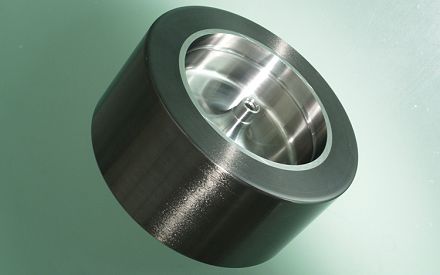
Flybrid's flywheel
But what exactly is KERS and how does it work? That question is answered quite well in yet another article, this time in the Motor Trend online magazine. Although the article assumes that we have a good deal more technical knowledge than may be the case, it does give us a general idea of how KERS can be achieved. There are two possibilities already in existence, it seems, one produced by Toyota (I can hear F1 fans shuddering at the thought), the other by Flybrid Systems LLP.
The Toyota sytem converts energy taken off at the drive train into electricity and stored in batteries. Flybrid, however, preserve the original energy source by use of a flywheel that can then feed the energy back in when required. Which all sounds very fine and dandy until one investigates a little more closely.
Apart from the weight of the system itself, Toyota's version needs at least ten gallons of oil to function properly. That's a fair bit of added weight for a F1 car and must inevitably require extra energy to carry around the circuit. Already we are seeing that nothing comes without a price and the vaunted energy recovery figures will always be offset to some extent by the energy requirements of the system itself. Any system that relies upon conversion of energy from one form into another will also suffer from a proportion of energy being wasted, this being multiplied if the energy is subsequently re-converted to another form. This also will be a problem in any attempts to use heat from the brakes as the source of energy to store and re-use.
The Flybrid system is considerably more efficient than Toyota's and has the advantage of not requiring energy conversion. Total weight is 55 pounds and it supplies the energy allowed according to F1 regulations. Once again, however, problems appear when we go into a bit more detail.
The flywheel will spin at 64,500 rpm, a speed that makes F1 engines look puny, even if allowed to go to 20,000 rpm. Less of a problem because of its simplicity and small size, the flywheel still gives rise to requirements that may not be so welcome. Special materials are required for the construction of the system and one wonders whether all are covered by the FIA's shortened list of permitted materials. This also implies considerable cost in manufacture, yet another clash with the FIA's cost-cutting drive. A figure of $1,000 per car is mentioned but this is only a theoretical estimate were the system to go into mass production for use in road cars. Add to all this the fact that extra energy will be required from the engine to get the flywheel up to speed and things do not look so great after all.
My point is not that KERS cannot save energy but more that it is less of a benefit than its proponents would have us think. Everything has its price and the ultimate saving in energy is tiny compared to the power produced by a modern F1 engine. KERS can only ever be a minor factor in any genuine attempt to limit the energy consumption of F1.
If Max expects KERS to take the heat from environmentalists off the sport, he is sadly mistaken. They will recognize it for what it is: a cosmetic applied to hide the truth. It is only a change to engines that do not require fossil fuels that will satisfy the green movement; anything else is just fiddling while Rome burns. Ideas such as KERS may have their place in road car manufacture but F1 needs to be spending its money in much more radical areas. Were the manufacturers to start now in designing hydrogen-powered engines, they could be ready in a few years to dump fossil fuels completely. KERS is just a waste of time and money for the sport.