
Last week I wrote an article entitled "USF1 - The case for" for Keith Collantine's F1 Fanatic. One of the comments took me to task because I had not really written the case for but had produced a rebuttal to a previous F1 Fanatic article by Peter Anderson, "USF1 - The case against". The commenter, Patrickl, was quite right; it had indeed been my intent to answer the first article's criticisms and I mischievously suggested that he read my blog to find out more about the case for USF1.
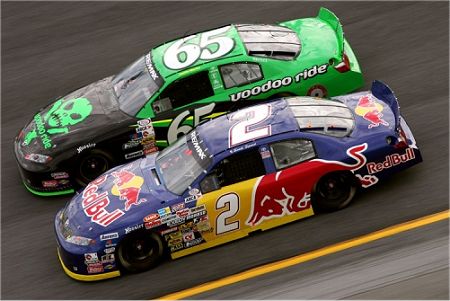
NASCAR race cars
Having said that, I feel duty-bound to go into more detail on the team as I am a recent convert and my previous posts have only touched the surface of what is being attempted. This paragraph is in the nature of being an apology for returning yet again to the subject of USF1, therefore, but it may be appropriate enough since my readers must be thoroughly fed up with reading about the Honda saga and the only other thing happening, the Jerez test, would be better written about once it has finished.
And so, to work. The big question mark hanging over any projected new F1 team is the matter of financing; without the necessary money being found, all speculation on engines, facilities, logistics and drivers are just dreams. So it is what Ken Anderson and Peter Windsor had to say about funding that is the most interesting part of the official announcement of the project. And funding means advertising money.
To understand what the team principals are saying about funding, it is necessary to look at the way NASCAR does it. Like F1, NASCAR teams tend to have one major sponsor and are often known by that advertiser's name; in addition, however, they have a host of smaller contributors and these are usually given a little space in a jumble of other names on the car. Take a look at the photo above and you will see the horde of logos clustered generally around the front wheelwell.
Each of those logos represents some funding injected into the team - but why do the advertisers do it when their name is so small and buried in a confusing riot of other names, rendering it effectively illegible to racegoers and TV audience? I have always maintained that the point of advertising is to get the name known amongst potential buyers; a TV ad may entertain, amuse or startle but, if it does not at some point hammer the product's name into the audience's heads, it is a waste of money.
So what are the NASCAR advertisers doing when they clutter up what would otherwise be a clean and tasteful color scheme with their myriad of unreadable logos? The answer lies in the still photos of the cars that fans will pore over before, after and during the season. In close-ups the logos become readable and the investment begins to pay off - the name is being seen and the inevitable connection with motor racing made.
What the USF1 principals have noticed is that F1 fans are fed an even more prolific diet of close-ups of the cars. Since every car is different and we want to know about the latest tweaks to a sidepod or wing, we demand pictures of the relevant area on the car as well as an overall view. And in these lies the smaller advertiser's opportunity.
When it comes to major sponsors of the NASCAR teams, we find that the vast majority have no connection with the motor industry; we can see energy drinks, supermarket chains, financial institutions, breakfast cereals, you name it, but nothing actually connected with racing itself. The reason is, of course, that these companies want their names to be associated with the the glamorous and exciting world of motor racing. Just to get the name across is achieving all they want and they pay big money for the prominence of their adverts.
If you were able to read the logos in the photo above, however, you would find that most of them belong to component suppliers or racing services companies - they are already connected closely with racing. They do not have the vast budgets of the primary sponsors but are aiming at a less diverse market than are the big companies. The intent is to be noticed by those who are already into cars and racing - they want the enthusiasts, like you or myself. We are the ones who will spend hours inspecting close-up photos of the cars, we are the ones who will notice a tiny logo and be interested enough to google the name to find out what that company makes.
And guess what? The next time we need to visit the car parts store to buy new shock absorbers, for instance, we will remember the name and its racing association. Our brand preference has been affected.
It is the basic theory of advertising and, no matter how much we deny that we can be influenced, the theory works or the producers would no longer advertise. And the small advertisers in NASCAR are actually targeting their ads more effectively than the big guys. Since the big company names are already well known, they are hoping only that the association with motor sport might persuade a few that somehow this makes them better than the others. The component makers are not so famous, however, and aim their advertising directly at those who are most likely to be in the market for motoring bits and pieces. It comes cheap and hits home - what more could be asked?
Ken Anderson and Peter Windsor have looked at the possibilities and concluded, with us, that it is highly unlikely that they will be able to win a major sponsor from outside the sport in such straitened economic times. They propose, instead, to find the necassary funding by totting up the contributions of a myriad of the companies that will supply them with components. They cannot find someone to give them $100 million so they will persuade say twenty suppliers to each let them have $5 million.
I believe this could be an extremely attractive proposition to American component companies. They have hit the good ole boys of NASCAR for years and know the effectiveness of having their names on the cars. Now suddenly they have the opportunity to become known internationally and to start selling their wares outside the States. As was pointed out in the USF1 announcement, UPS and FedEx have made delivery worldwide a commonplace thing - for such transportable objects as car components, delivery distance means nothing anymore.
F1 also has a mystique felt even amongst the NASCAR fraternity. For a shock absorber manufacturer to be able to say that their products are used in F1 will be a big selling point everywhere. It is a huge marketing opportunity that will be recognized even now, when money is tight.
When USF1 was first rumored, I thought it was an impossible dream. From my F1-centric thinking, it appeared out of the question that the necessary funding could be found - and, without the money, it doesn't happen. But Peter and Ken have shown me that it is not only possible but quite likely that the funds can be gathered together from many sources. They have a new concept that might well influence the way F1 teams go about financing in the future.
It may not work - it remains to be seen how effective Ken and Peter are in enthusing American investors. But we would be fools to dismiss their attempt merely because it has not been done before. The proof of the pudding is in the eating and I, for one, am looking forward to a hearty meal in the 2010 season.