
The stewards' penalty dished out to Hamilton at the Belgian GP is still occupying my thoughts. I have read all the comments (currently at 415) on Keith Collantine's post on the subject, plus countless others on other blogs and websites. And it seems that no one is getting the point, in spite of Alianora's clear explanation of the rule under which the penalty was given.
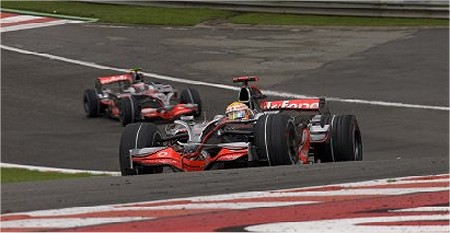
Lewis Hamilton
All the claims of gaining an advantage or not, slipstreaming, bumping off at the chicane, how much Hamilton should have given back, etc. are utterly irrelevant. The penalty was for Hamilton's breach of Article 30.3(a) of the Sporting Regulations which states this:
During practice and the race, drivers may use only the track
Complicated, isn't it? That is the rule the stewards chose to enforce and that is all we need consider in our debate on the matter. And it is quite clear that Hamilton did indeed depart from the track in his progress through the chicane. That should be the end of the story but the rule is so all-encompassing that, were it to be enforced to the letter, almost every car in the GP would also have to be penalized.
Contrary to the assertions of so many commenters, nowhere in the rules does it mention that an advantage gained by an off-track excursion has to be returned, it is never stated that leaving the track and returning without advantage is allowed, it does not say that the driver must wait a corner or two before attempting to pass again. Section 30.3(a) is all we have to go on.
So where does this idea that drivers will be forgiven if they return the advantage come from? We have seen so many instances of such an action in the past that it is natural that we assume it is somewhere in the Rulebook. But the truth is that it is a convention, something accepted by the sport without it ever being written anywhere in black and white.
The fact that the stewards append their opinion that Hamilton gained an advantage through cutting the chicane is an unnecessary addition if they are using Section 30.3(a) as their justification for the penalty. And that immediately begs the question: So why did they choose to pick on this one instance of an infraction against Section 30.3(a) and none of the many other instances? One can see why there is a widespread feeling that the FIA has a pro-Ferrari bias. But I will come to this question in just a moment.
The actual offence that Hamilton is accused of is defined as follows:
Cut the chicane and gained an advantage
In this instance, it appears that the stewards were not interested in applying the convention of returning the advantage. All the arguments over how much of an advantage should have been returned are wasted, therefore - the stewards have not been there. They seem to be saying that, because Hamilton returned to the track ahead of Raikkonen, an advantage had been gained; there seems no interest in whether the advantage was returned.
So they have decided to ignore the convention and impose a penalty purely under the terms of Section 30.3(a), with an attempt to explain why other infractions during the race have not been penalized. Hamilton gained an advantage, others did not, apparently. But this ignores Raikkonen's use of the run-off area around Pouhon to cut the gap to Hamilton and challenge him at the next corner. And it is no argument to say that Raikkonen took himself out of the race later - there are penalties available that could apply in the next race.
So again, we are left wondering why only this instance of rule-breaking merits a penalty in spite of the convention having been adhered to. Now it gets a little murky and those of a nervous disposition are advised to read no further. To establish the reason for the investigation, we have to look at how it was started. There are three ways an investigation can be initiated - the Race Director may compile a report on the incident and send it to the stewards, the stewards can decide on their own to investigate, or a protest can be received from one of the teams involved. The following is what the stewards say happened in this case:
The Stewards, having received a report from the Race Director and having met with the drivers and team managers involved, have considered the following matter, determine (sic) a breach of the regulations has been committed by the competitor named below and impose the penalty referred to.
That sounds as though it was the Race Director who began the process by sending a report to the stewards. Journeyer has pointed out in a comment on my previous post regarding the penalty that it does not have to mean that, but it seems likely, in view of the fact that the first thing mentioned is the report. In addition, a post on Grand Prix dot com seems to confirm my reading:
The Stewards do not act on their own. They react to reports delivered to them by the F1 Race Director. This is Charlie Whiting, a former Brabham F1 mechanic who worked his way up to the position and works out of the same office as Max Mosley in Monte Carlo. In Spa Ferrari very carefully made sure that the media knew that it had not protested the result of the race and that the action was based on a report from Whiting.
So it looks as though it was Charlie Whiting who started the whole thing. But McLaren have maintained that, on seeing the incident, they immediately asked Race Control if Hamilton's return of the advantage was sufficient:
From the pit wall, we then asked Race Control to confirm that they were comfortable that Lewis had allowed Kimi to repass, and they confirmed twice that they believed that the position had been given back in a manner that was 'OK'. If Race Control had instead expressed any concern regarding Lewis’s actions at that time, we would have instructed Lewis to allow Kimi to repass for a second time.
Who is in charge of Race Control? Why, Charlie Whiting, of course (in fact, Ron Dennis said that it was Charlie that he spoke to). This puts the Race Director in a rather unsavory light. First he assures McLaren that the move was okay, then he writes a report to the stewards, asking that they investigate it. In effect, he was ensuring that there was nothing that McLaren could do to put the situation right. If that does not indicate an intention to prevent a McLaren victory, then why would he lie to the team?
Indeed, there is some irony in the situation in that it might have been McLaren's inquiry that gave Charlie the idea in the first place. That would be entirely in keeping with Ron's apparent talent for trying to do the right thing and then being blasted for it. But it is speculation, so I will let it pass.
The whole thing looks as though the FIA (not necessarily the stewards - they were merely doing their job as instructed by the FIA's Alan Donnelly) will look for ways to penalize McLaren at every opportunity. I know that sounds insane, but what else am I supposed to make of this latest in a long list of strange FIA decisions against the Woking team? As has been said so many times before, no matter how badly written the rules, let us at least have some consistency in their application. To allow Massa to escape with a fine for an offense against a safety rule at one race and then demote the victor at the next race for breaking a sporting rule is just indefensible.