
During the course of the pit stops in the Valencia GP, there were at least two more incidents of spilled fuel igniting to cause brief fires. Little comment has been caused by these, perhaps because the issue of Ferrari's nominal penalty for Massa's unsafe release from his pit has generated much more controversy.
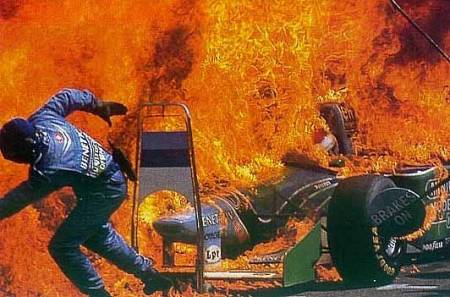
Jos Verstappen's pit stop fire, German GP 1994
Even so, it seems strange that such fires were deemed newsworthy in Hungary but not in Valencia. I can only assume that the explanations of the teams have been accepted and we can return to our usual complacent attitude towards refueling during the race. To me, however, the attitude that the ignition of fuel spills is a normal event and nothing to worry about seems somewhat short-sighted.
In Valencia there was a pit stop (I cannot remember with which particular team) where spilled fuel ignited before release of the fuel hose. It seems to me that it was luck more than anything else that the fire did not spread into either or both of the car’s fuel tank and the delivery system. We can talk of shut-off valves preventing such an occurrence but should remember that this is the same delivery system that has suffered a long list of jammed and malfunctioning valves over the years. Put a flash fire with an obstinate valve and you have an explosive situation.
The very fact that fuel spills during re-fueling shows that the delivery system is less than perfect. Why it should be impossible to design a valve that will not open before proper connection with the car's filler and then shuts too slowly on disconnection, I do not know. Apparently, it is, and the teams must accept a certain amount of spillage during each pit stop.
The most important argument against re-fueling during a race remains the possibility of a serious fire, similar to or worse than Benetton's experience with Jos Verstappen's car during the 1994 German GP. We might suppose that the long period without a major fire incident since then means that any problems have been solved; I submit that the number of flash fires seen recently is evidence that they have not. It is luck more than anything else that has prevented a serious fire from occurring. When we add the possibility of high voltage from KERS systems, so recently and dramatically in the news, increasing the chances of accidental ignition of fuel, it seems that F1 is playing with fire beyond acceptable limits.
The nonsense of the stewards’ decision on the unsafe release of Massa’s car from his pit shows just how complacent about safety the officials have become. It remains to be seen how long it will be before there is a serious accident as a result of this but the unconcerned attitude regarding fire in the pits must increase the chances that the next "big one" will happen during a pit stop.
Re-fueling during the race was introduced to add to the spectacle of F1. Many, including myself, feel that it has merely served to enforce the strategy of waiting until the pit stop before attempting to overtake, thereby assisting in the creation of featureless races so well exemplified by the Valencia GP. Motor racing fans care less for the intricacies of fueling strategies than they do for the actual performance of the cars and drivers on the track.
Surely it is time that the re-fueling experiment was ended and the cars designed to go the race distance on a full tank. From a safety point of view alone, this seems the best way to go.