
Two days without a post - I'm so ashamed. The problem is that nothing much is happening on the race or political scenes at the moment and nothing occurs to me historically. So I have been idly browsing my favorite blogs and news sites, looking for something to spark me off - and I found an unexpected subject on Rob Ijbema's Car-a-Day blog.
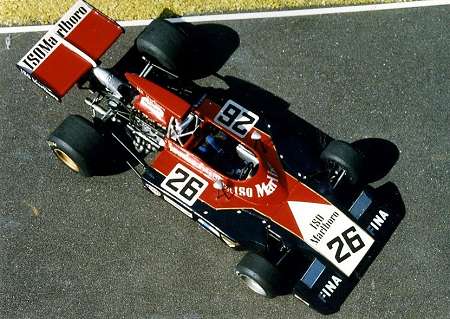
1973 Iso Marlboro (courtesy of Rob Ijbema)
Rob allows me to use the occasional photo of his paintings to illustrate my posts but it was not a picture that caught my eye this time. A couple of weeks ago he wrote a post on some models he made a long time ago. As can be seen from the photo up there, he does a brilliant job, but it brought back memories of my own modelling days.
In the early eighties a friend and I used to meet after each GP and stage our own mini-GP using our combined Scalextric sets (slot racing). He was the track expert and would create very good replicas of each circuit, while I was the car man. Our big problem was that Scalex make very few models each year, so we had to create the grids with incorrect cars dubbed as the real thing. There was another slot car manufacturer whose models could be pressed into service but there were never enough and I found it frustrating that so many of our cars were pretending to be something else.
That frustration finally got the better of me and I started making cars using sheet plastic and Scalex spares. The first, the 1983 Tyrrell 011, was actually built using pieces cut from a kit of an ocean liner someone had given me (and had tiny portholes running along its undertray as a result!). To my surprise, it proved just as strong and performed as well as the Scalex cars and so I started churning new cars out as fast as I could.
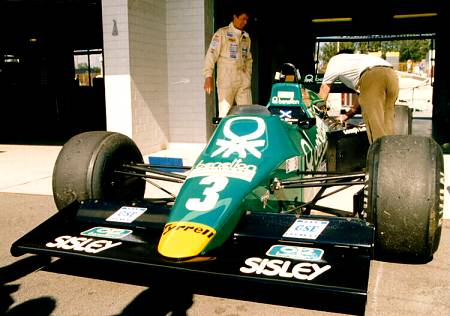
1983 Tyrrell 011
Along the way, I was learning what made the cars handle well or badly and eventually I could duplicate the performance of the real thing, so that we did not have the Osella team suddenly winning all the GPs. I became fanatical about visual detail, too, duplicating the colors down to the smallest advertising logos and painting the helmets in the correct designs.
By the time everything came to an end, we were running two seasons, 1977 and 1984, on alternate weekends and about twenty of the cars were hand built. By then I was obsessive about detail and each car took longer to build than the previous one and so it came as a relief when we had to call it a day. But I can tell you that Nelson Piquet was the actual winner of our 1982 championship, not Keke Rosberg!
This may seem a departure from the rough and tumble of F1 as it is today but, on a quiet day, I thought it might remind many of you of your own modelling endeavors. I know that most of us either build or collect models so you might excuse me this one lapse into nostalgia...