
No doubt we all chuckled at the news that Honda's F1 team have cancelled its usual media lunch in an effort to cut down on expenses. Coming on the heels of the revelation that Honda spent more than any other team in 2008, this sounded a bit like a multi-national corporation saving money by rationing the paper clips. The fact that the team's Christmas dinner for staff has also been vetoed, makes the problem seem a good deal more serious, however. Companies are a bit more worried about costs when it becomes necessary to forget such extras - the happiness of employees is as important to a team's future as finances, after all.
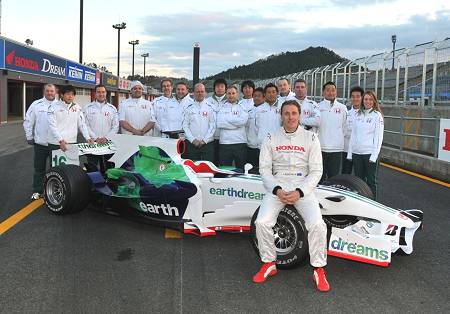
Honda F1 team
Now it seems that an important meeting will take place at the Brackley team headquarters today. Rumor has it that the aim is to reduce expenditure in a big way and redundancies have been mentioned. Matters have obviously come to a head and the Honda F1 operation is likely to be severely cut back as a result.
This is the clearest indication that the economic climate is beginning to have practical effects within F1. When a large manufacturing company like Honda has to slim down its team budget, reality has invaded cloud cuckoo land. It is especially relevant that it should be Honda feeling the pinch; as one of the big spenders on staff and research (but with very little to show for it), the team has had a rude awakening over the last few days.
Meanwhile, another meeting will be taking place in Geneva, with representatives of FOTA discussing the matter of cost-cutting (amongst other things) with the FIA. With Honda's troubles fresh in our memories, it is impossible not to think that some matters on the Geneva agenda, medals and qualifying systems, for instance, are highly irrelevant in the present economic climate. But suggestions for cost-cutting strategies are said to be the priority of the meeting, at least.
Whether any of the proposals will be sufficient or swift enough to deal with the coming crisis remains to be seen. Most of the suggested changes will not take effect until 2010 at the earliest and new regulations for the coming season (KERS and redesigned aerodynamics, for examples) have already committed the teams to additional expenditure in 2009. Yet the credit crunch is here now and already banks are being propped up by governments as they experience the full effect of the downturn.
It all makes it pretty clear that the governing body of the sport cannot react quickly enough to changes in the world economy. Although there has been talk of reducing costs for a long time, measures can only be taken at the appropriate times - at the end of a season, that is, when the regulations can be altered. So it is quite possible that, by the time any agreement made in Geneva begins to have an effect on F1 budgets, the crisis will already have passed and such drastic measures be no longer necessary.
The example of Honda gives us a blueprint for how these things really work. Reality decides just how much a team can afford to spend, not regulation. If this season's regulations stayed in force, teams would have to cut their cloth according to the resources available; some would find it hard going while others would find a way to spend the money anyway. And the likelihood is that it would be the same teams at the front using their more extensive budgets to advantage, while the usual stragglers struggle in their wake. It has always been so and, although throwing money at an F1 team will not guarantee success, it is generally the better-funded teams that do well.
So I wonder whether all this panic over costs is really achieving anything at all. The danger is that, by the time the economic climate eases, we may find that the sport has been so radically altered as to be unrecognizable. Standard engines will create a spec series and we have enough of those already. It is a major part of F1's appeal that the teams are involved in a design and engineering competition, not just a driver's championship, and without this, the sport will not be worth watching at all. Once that happens, survival of the sport becomes irrelevant.
I suppose that I am suggesting that everything be left pretty much as it is; let reality sort out how the teams will cope with decreased funding. It sounds like an irresponsible strategy but it will be what happens anyway, as demonstrated by Honda. The important thing is that F1 survive as a sport still capable of attracting the interest of millions of fans. That is the essential ingredient to the success of F1, not its relevance to road car technology or how much it can bend itself to appease the green lobby.
As with most things, I think it's a case of the less meddling by officials, the better.