
Robert Kubica's collision with Jarno Trulli in Sunday's Chinese GP, apart from being the most spectacular incident in the race, was also strangely reminiscent of the Pole's horrendous crash in the Canadian GP of 2007. No doubt everyone remembers that one, it being the worst accident in F1 for many years and it still seems incredible that Robert emerged from the battered remnant of his car without serious injury. No one seems to have noticed the odd coincidences in the Shanghai collision, however.
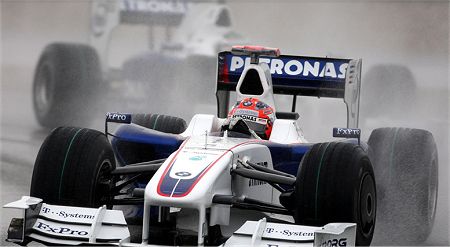
Robert Kubica in the rain
It was Trulli that Kubica ran into in Montreal at the beginning of that accident; it was Trulli again in China who got in Kubica's way. Both incidents were caused by Kubica realizing too late how close he was to the Toyota driver and failing to dodge around him in time; both resulted in the front of Robert's car running into the rear wheel of the Toyota and the front of the BMW being thrown into the air as a result. In China the flow of air hitting the underside of the BMW was insufficient to flip the car, thanks to the lower speed of the collision, but it looked as though Robert's race was run, so high was the front of the car at one point.
It was especially amazing that both cars were able to continue, Trulli to retirement in the pits and Kubica for the rest of the race after having a new nose cone fitted. Just as in Canada, we had cause to marvel at the strength of the modern F1 car. What really astounded me was that they could fit a new nose to the BMW - it looked too mangled for all the necessary joints to be intact.
So I draw a few matters to ponder from the incident, the first being the superb design of the cars today. That the Beemer could be thrown up into the air like that and still be driveable after crashing back to earth is a testimony to the success of its designers in meeting the requirements of both lightness and strength in chassis and suspension.
In a recent post, I pointed out how strong the front wing of the Brawn BGP 001 seems to be, Barrichello's having survived unmoved by a couple of collisions in Melbourne. Now Kubica has demonstrated that the BMW too is much stronger than appears.
I am reminded of the widespread fears of the pre-season that the new wider front wings would be knocked off so easily and frequently. Not so, it seems; there have been no more incidents of noses having to be replaced than in previous seasons. Ironically, Kubica was one of the most vocal of the drivers in his doubts about the new wing - perhaps he was testing to see just what was needed to detach it.
And then there is this strange attraction between Robert and the rear of Trulli's car. Is there some mysterious force at work that draws the two together in so calamitous a fashion? A point to ponder indeed.
It was also Toyota that showed us a new trick in connection with front wings. Normally, when a car requires a new nose cone, the mechanics lift the front of the car through sheer muscle power, there being no way to fit the jack beneath a non-existent nose. But when Glock came in for a replacement, the Toyota boys merely slipped a trolley under the body of the car, lifted the whole car and a new nose was fitted while the tires were changed.
The whole process took no longer than a normal pit stop for fuel and tires and it will be no surprise to see other teams adopting so efficient a procedure. Hats off to Toyota for seeing a way to speed things up even further.
But the team must have trained for the new method - it was so slick and unfussy that they had obviously done this before. And it may well be that it was fear of the increasing incidence of mangled noses and front wings that motivated the idea. We are three races into the season and this is the first time we have seen the new system in operation; which must surely say that those fears were unfounded. It is a clever idea all the same and bound to be adopted by all the teams.
Unless someone finds an obscure regulation somewhere and puts in a protest, of course...