
GMMF1.NET has put together an interesting article regarding the introduction of KERS next year. Although it is normal for doubts to be expressed over any change in F1 rules, the number and status of those having misgivings, as revealed in the article, is worrying, to say the least.
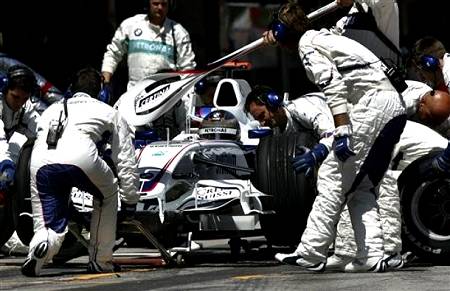
Careful, don't touch the car!
Following the problems encountered by teams in the development of KERS systems for 2009, it is now suggested the voluntary debut of the technology might need to be delayed.
The highest profile problems experienced by teams include the recent smoke and fume incident at Red Bull's UK factory, and the electric shock sustained by a BMW-Sauber mechanic at the Jerez test this week.
Toyota engine boss Luca Marmorini tells the German magazine Sport Bild: "All teams are having problems at the moment.
"Building a safe system is proving a difficult thing. For 2009, time is running out," he added.
"To me, it would be more logical to test it for a year before we use it at the races. For us at Toyota, safety has the highest priority," Marmorini said.
Williams driver Nico Rosberg explained: "For the first few races (of 2009), no team will be on the grid with KERS.
"It is Williams' plan to introduce it for the first race, but that is a big task," the German driver added.
Honda team principal Ross Brawn is believed to have said a similar thing.
Renault team boss Flavio Briatore told the German newspaper Bild-Zeitung: "If the system is not safe, we will not put it on the car."
Speaking for the drivers' safety union the GPDA, Mark Webber said: "Some teams are having problems with the chemicals that are used for the batteries.
"It is important to us that it is safe, when we are driving at 300kmh, or in the event of a heavy accident."
GMMF1.NET
That is an impressive list of doubters. When we include the fact that the value of KERS is largely offset by a weight penalty and that its intended use is to be by a "push-to-pass" button, surely anathema to any F1 fan, the whole idea has to be questioned. This was a cosmetic addition introduced by Max Mosley in an attempt to make the sport appear more environment friendly and, quite frankly, it does not fool anyone. Early experiments have proved it to be complex, difficult to implement and dangerous in ways that were not anticipated.
It looks to me as though F1 could save itself enormous expense and difficulty if the rule were to be scrapped now, before the teams invest too much in it. Even to delay its debut for a year is to ignore the fact that it was an attractive notion that will never deliver on our expectations of it. The only place to find a free lunch these days is on the internet and KERS is anything but free energy for no cost.
If F1 is to be genuinely concerned about the environment, it has to be interested in alternative fuels. Anything less is a compromise and a cosmetic application while the engines continue to burn off fossil fuels that are finite in supply and damaging to the atmosphere. What frustrates me more than anything else in the matter of the greening of motor sport is the continuing ignorance of fuels that offer a viable alternative right now.
Hydrogen may not be the fuel of the future (although I think it is) but it is certainly available now and requires very little change to the engine and systems to work as efficiently as gasoline. As a stop-gap measure, it is the obvious answer.
But no, instead of looking at alternative fuels that will make the sport truly environment-friendly, the teams are expected to fiddle about with costly add-ons that require a great deal of development time before becoming workable and, in the meantime, the original intent to make the sport greener is forgotten. Do not be fooled; Mosley is not interested in making F1 green, he is only concerned with making it appear green.
As part of his campaign to stay on as FIA president, Mosley has recently asked the teams to submit their suggestions for F1 in the future. A first meeting was held over the German GP weekend to begin to thrash out some ideas. Judging by previous experience, however, it is all a waste of energy and time - Mosley never listens to such suggestions and just throws them out in favor of some half-baked scheme of his own. We are saddled with a five-year engine freeze as a result of his last attempt to appear reasonable.
Sooner or later the teams are going to have to recognize the fact that F1 is being destroyed by Mosley's continued tenure. As the ones with the biggest stake in the sport, they are going to have to stand up to the FIA and insist that he go. And, if that means a breakaway series, then so be it.