
Max Mosley has given an interview to the BBC in which he answers questions regarding his recent meeting with FOTA over the rule changes slated for 2010. Many have picked up on the fact that Max calls Toyota's John Howett "childish" at one point but that is the kind of thing we have come to expect from him and hardly worth a comment. There are more interesting matters in the interview anyway.
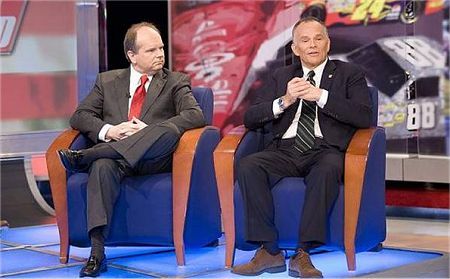
Ken Anderson and Peter Windsor
Apparently, the issue of a two-tier F1, ostensibly the cause of the FIA/FOTA disagreement, has been set aside already. Mosley states that the idea of giving cost capped teams more technical freedom was to help new teams to be reasonably competitive; with some existing teams opting for the cap, however, the need for a technical differentiation falls away - it would be handing a huge advantage to teams like Brawn and Williams.
This amounts to a retreat by the FIA, evidence that Max is beginning to realize that he has pushed the teams too far this time. The excuse of allowing new teams to be competitive is an invention intended to hide the climb-down. Before the meeting the reason given for a two-tier formula was to allow the big teams to continue to spend as much as they liked; which ignores the fact that FOTA is interested in cutting costs but objects to the arbitrary figure of £40 million being imposed.
And that is the sticking point as far as Max is concerned - he will not be moved on the amount of the cap. To support his position, he cites the number of teams lining up for entry to F1 now that the budget cap seems inevitable; he fears that such teams will drift away if the cap is fixed any higher. But the reality is that there are only two serious candidates so far, USF1 and Lola, and both of these decided on entry without the rules being written in stone.
USF1 announced their F1 entry long before the budget cap was mentioned, as is clear from an interview they gave to the F1 website recently. Peter Windsor and Ken Anderson made their decision because costs in the sport were already coming down as a result of FOTA's cost cutting exercises for 2009. They were looking then at a budget of about £100 million so an increase of the imposed cap beyond £40 million is not going to worry them.
Lola has made a commitment to enter the sport while the furore over the cap remains unsettled. They cannot expect that the cap will remain as Max wants, therefore, but have decided to enter anyway; which means they have taken into account the possibility of the figure being increased substantially.
The other wannabes are waiting for a result before committing themselves - thereby indicating that they are marginal on financial ability to run a team in F1. Whilst it is good that new teams enter the sport, F1 hardly needs a repeat of the farcical attempts by underfunded teams that it has seen in the past. So the argument that the new teams prevent any increase in the cap suggests that F1 would remain viable with the few existing independent teams and a horde of new ones. I doubt that Bernie Ecclestone relishes that thought.
Max's confidence relies heavily on the belief that the manufacturer teams will give up the fight eventually and submit their entries for 2010. Ferrari is cited as the the sole potential loss to the sport and it is true that they are the most determined to see a change in the government of F1. But Toyota too has had enough and is quite likely to leave at the end of this year, regardless of what happens politically. The others appear happy to follow Ferrari's lead for the moment.
While Max may think that the issue is the budget cap, it is much more that the teams are fed up with his dictatorial style and want to be rid of him. That is the reason for Ferrari's application for an injunction on the FIA and the result of that court case may well decide how everything else pans out.
If the injunction is granted, all the proposed rule changes become void and the FIA will have to consult with the teams on any changes to be made. At which point, any reasonable president of an organization would resign, his authority undermined and leadership questioned. But Max has shown that he does not give up easily and the war would continue until no rule changes for next year are possible.
We live in interesting times.