
Lately it seems that every race has its controversy, its storm in a teacup hotly debated with passion and reason, its opportunities for bashing or defending the drivers involved. A couple of weeks ago it was Kimi taking out Sutil in what was clearly a racing accident, no matter how unfortunate for both drivers. Now Lewis Hamilton, the most inventive of them all when it comes to creating new ways to exit GPs (and thereby stir up the punters), has wowed us with a stunningly original way to take out a competitor: boot the guy up the backside while he's waiting at the lights. It is only a pity that this method tends to ruin your own chances of winning too.
Joking aside, I fail to see what the fuss is about (just as I must have missed the point in the Raikkonen/Sutil deal). Hamilton merely gave us a perfect demonstration of the classic traffic light rear-ender. He did not say as much afterwards, but part of his embarrassment must have been that he had fallen for the most common foul up on our roads today.
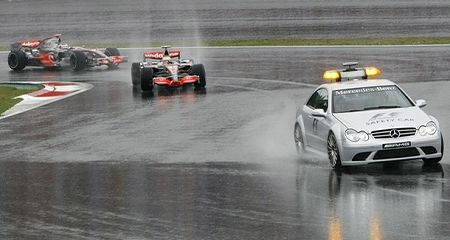
Consider the circumstances; Hamilton is impatient to leave the pit, having seen his lead destroyed by the pace car and knowing that all the guys just behind him were pitting at the same time. But his team are filling his car with more fuel than the others and the inevitable happens - Robert and Kimi beat him to the punch. And now we have the scenario all ordinary drivers deal with every day - a bunch of cars nose to tail approaching a traffic light.
If you have driven for a few years, you know what happens next. You're following the car in front closely, they're trundling along at the speed limit, you approach the lights, you glance up to see whether they're green or red... In that instant the driver in front of you brakes because he looked a second earlier and knows the lights are red. You look down and it's already too late - a collision is inevitable. That second or two you lost in checking the lights has been enough to transfer you into a space already occupied by the car in front.
Remember, too, that Hamilton and Rosberg did not have the split second's advantage of seeing brake lights come on - F1 cars don't have them. So that glimpse at the pit exit lights was absolutely imperative to predict what the cars in front were going to do but also robbed them of the chance to stop in time. It is the fans who suspect Hamilton of deliberately choosing to ram Kimi rather than Kubica who make me laugh loudest; I know these drivers have super quick reflexes but come on, they're not superhuman.
There we have it. The originality of Hamilton has introduced the rear-ender as another new way to exit a GP, an invention so brilliant that Rosberg was moved to copy it immediately, so dazzled was he. But that is not good enough for us; we have to pick it apart, imagine all sorts of ulterior motives, dastardly plans, accuse this one or that of stupidity, anything but accept that this was a simple accident caused by cars following each other too closely (which happens in racing, especially if you bunch them all up in a narrow space and limit their speed).
Much more interesting than the question of why it happened is to ask why it has not happened before. And the answer to that one is in the statistics - there just weren't so many opportunities for this kind of thing to happen before the new safety car rules were brought in. Up until the Canadian GP, the red light was becoming notorious for ruining the races of those who did not notice it was on; now we know what happens when they do and stop as instructed.
There is a lot of debate about why the pit exit should be closed while the other end remains open - all explained by the necessity to hold cars back while the pace car and its train are passing the exit. But why is nobody pointing out the fact that the whole silly business is caused by unworkable rules being introduced without consideration for their side effects?
The new rules were introduced to stop the pit lane becoming overcrowded as soon as the safety car comes out. As we saw in Canada, they have failed miserably in preventing that situation and have only created several other opportunities for things to go wrong. Let me ask a question: when exactly, before the introduction of the new rules, did we see accidents in the pitlane caused by overcrowding? Maybe my memory is at fault but I cannot recall a single instance.
It is just another example of the FIA fiddling while Rome burns; make fancy new rules to cover situations dreamed up in your imagination and then add adjustments as events prove your idea to have been unnecessary and flawed. Mr Mosley has done such a great job, hasn't he?
I have said before that the problem lies even further back than the introduction of the new rules - the safety car was an ill-conceived idea in the context of F1 and it has ruined more than its share of great races. Of course, I know it is too late now for that mistake to be rectified; we have become used to its appearance and the artificial reshuffle that it creates. But I can dream of it finally getting the boot by the introduction of a better way of handling accident situations, can't I? Maybe there is some genius out there who can suggest a method of slowing the cars to a safe speed without forcing them to bunch up into a traffic jam.