
Practice for the Japanese GP proved only that the McLarens and Ferraris are closely matched, as expected. Timo Glock's surprising fastest lap in the second session was most likely a PR exercise achieved on very low fuel, whereas Alonso's second spot was largely the result of his ability coupled with improvements to the Renault. Come the race, it will be business as usual, I expect, with the big two teams romping away from the rest.
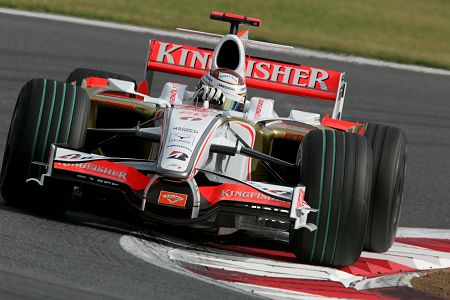
Adrian Sutil impresses in practice for the Fuji GP
Away from the track, some interesting things have been happening. Vijay Mallya is reported to be talking to McLaren-Mercedes about an engine supply for next year - which is somewhat surprising, given that he has a deal with Ferrari for 2009 and the Italian engine is reputed to be the most powerful at the moment. Word is that Force India do not get the engines "adjusted for reliability", however, and the team is limited to the power available at the beginning of the engine freeze as a result.
At this point we are entitled to ask "What engine freeze?" With some teams exploiting the rules to extract more power from their supposedly frozen engines while others have stuck to the spirit of the rules, it has been apparent for some time that the freeze is not working. Even Max Mosley has been forced to admit its impracticality with his announced desire that the engines should be equalized, if necessary by the introduction of a standard engine.
That has the manufacturer teams in an uproar, since it would negate the very reason for their being in the sport. FOTA becomes a hotbed of alternative suggestions (just as Max intended) and Mercedes announces that it is prepared to supply engines to other teams - a fairly obvious ploy to be the chosen designer should the standard engine become fact. It used to be that each engine manufacturer could only supply engines to one team apart from their own but the FIA have rather blown that one away by allowing Ferrari to sell engines to both Force India and Toro Rosso. If Mercedes want their engine to be used by three or even four teams, the FIA can hardly refuse now.
Which illustrates the state of permanent change in the sport at the moment. The teams have been complaining at the way in which the rules are constantly being tinkered with and have asked for stability; instead, they hardly know what will be required for the next GP, never mind next year. And every rule change means more expense, making a nonsense of the FIA's determination to cut costs.
The problem lies in the exceptionally bad rule-making that the FIA indulges in. They have introduced a series of rule changes over the last few years, all of which have proved unworkable or damaging to the racing. And so they fiddle with settings, trying to get bad rules to work as intended, and usually end up making things worse. The present safety car rules are an example. Introduced to prevent a theoretical problem, they have given rise to all sorts of injustices in the races. This will be changed in the new year, apparently, although the chosen solution is not ideal.
We are left with the impression that the sport is being run by incompetents. While the FIA is very good at setting lofty goals such as stability, economy and eco-friendliness, they seem even better at devising rules that make a mockery of such ideals. And FOM is no better, summarily axing races without warning, then giving mealy-mouthed explanations like "contractual differences", which we all know means the organizers cannot afford to pay Bernie's ludicrous asking price.
The wonder is that F1 somehow manages to continue as the great sport it is. If anything is constant in its rarefied atmosphere, it is that the best drivers still compete in the best cars and we are provided with a championship that goes to the wire whether or not the stewards interfere. How long this can go on while the basis for the sport remains so much in turmoil and flux, I do not know; but I suspect that the manufacturer teams are getting extremely fed up with it all.
To me, it seems that the sport can go one of two ways. Either the present regime stays in power and the growing discontent in the teams reaches boiling point (and that would pull F1 apart, whether or not a rival series is set up), or Max and Bernie are somehow deposed and a more realistic and able leadership instituted. The second option is extremely unlikely, given the way the two have entrenched themselves, but that leaves only bloody revolution to look forward to.
I hate to say it, but it looks increasingly as though F1 is about to self-destruct in the same way CART did in the last decade. And at the root of both there are a few greedy, power-hungry guys without a scruple between them.
Okay, enough doom and gloom for the moment - I'm still looking forward to watching the Fuji race in the small hours of Sunday morning.