
It is somewhat ironic that, at the moment F1 finds itself without a USGP, the debate on the future of the sport turns heavily on the success of America's premier motor racing format, NASCAR. In the States, NASCAR's victory over open wheel racing is complete, with CART a shadow of its former self after years of division and unsuccessful evolution. The masters of F1 look longingly at the stock car format's success and, as evidenced by FOTA's first suggestions, they seek to emulate it with radical changes in their presentation of F1 to the public.
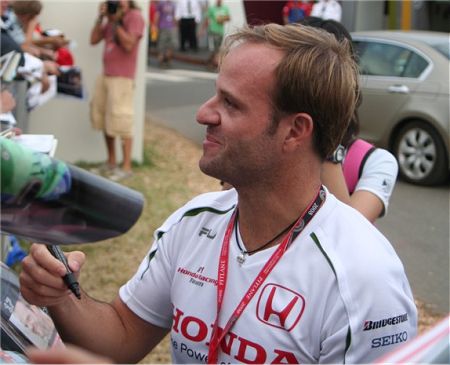
Barrichello meets the fans
On the face of it, this makes sense; if your business is failing, what better way to turn it around than to study the methods of your successful competitors? But that needs examination before any hasty changes are made. For a start, is F1 really failing in its quest to reach an ever expanding audience?
The answer to that has to be, "Not so far, no". Actual attendance at races may be down but the days are long gone when the sport would count on gate receipts for its major source of income. These days it is the television ratings that matter more than anything else and it is not just the money paid in by broadcasters that matters here - the exposure of the sport to such a huge audience brings in the advertisers and sponsors that fuel the expenditure required by F1. Even allowing for some inflation of the figures by those who produce them, the ratings continue to put F1 at the second most watched sport in the world and that can hardly be defined as failing.
So it is not the present that drives the sport's search for more cost effective ways to fund itself; it is fear of the predicted economic downturn that threatens to squeeze sponsorship and the budgets available for research and development of the cars. Hence the calls for standardizing everything in sight - it is an obvious and easy way to save money.
But F1 has to recognize that things are a little more complicated than that, given its present dependence on the motor manufacturers for filling grids. It is against the manufacturers' interests to be limited to standard components because this attacks their reason for being involved in the first place - the exposure of their brand name as a hallmark of excellence in engineering competition.
This forces FOTA and the FIA to look at other ways of keeping the dollars rolling in at a time of economic restrictions. Now the apparent success of NASCAR seems to point the way for a bright future for F1 and we get suggestions such as the sideshows mentioned by Martin Whitmarsh this week. He does not say the word "NASCAR" but we all know where the idea came from.
At this point, my particular circumstances allow me a rather different perspective on the subject; as an Englishman resident in the States, I can see both sides of the motor sport equation and I fear that the European masters of F1 are missing some important points here. The fact is that motor racing in the States and in the rest of the world are very different creatures and they have totally different audiences as a result.
I have looked at this to some extent in this blog before and my American readers have confirmed that, in the States, an interest in F1 is a connoiseur's pursuit, as opposed to the common mania for NASCAR. It is as if the BTCC were to have a following of millions in Britain while F1 were relegated to the status of a minority interest for the purist. And we know that just is not true.
History gives us the reason for this variation in approach to motor racing between the two originating continents. It is a huge subject and it suffices here to point out that, essentially, Americans are interested in how fast the thing can go, Europeans want to see how well it corners. F1 has always struggled to convert American viewers because average speeds in a GP are so much lower than those attained by CART and NASCAR vehicles on a banked oval track. Where are the top speeds over 200 mph, they want to know, where the tire smoke, massed packs of cars circulating together, the over-excited commentators, the bragaddocio from drivers with massive egos?
It is a different world. I have tried very hard to get into NASCAR but have had to face the fact that it just is not my "cup of tea". To me, the speed that cars can attain around a banked track is highly irrelevant, the car-mangling accidents and hyperbole of the presenters leaves me cold; give me rather the sight of a Senna on a damp track controlling his car at the very limit of adhesion and destroying the opposition through pure skill.
I am not saying that one approach is better than another; it is a matter of taste and F1 needs to recognize that its selling points are completely different from those that sell NASCAR. The existing fanbase will not be entertained by sideshows and alterations to the existing format of F1 - they watch it as it is because they like it like that. Go too far towards making the "show" more spectacular and F1 will lose as many of its present fans as it gains from the general public.
There is one recurring theme in the discussions on learning from NASCAR, however. And that is all about accessibility, particularly of the drivers but also of other members of the teams (F1 fans care about the whole team, knowing that the car is as important to success as is its pilot). Elsewhere I have made the suggestion that F1 needs to open itself up to the public much more than it does at present - and that means the TV viewers as well as those who can attend races. If there must be change, let it be in the area of F1's secrecy, its fear of letting out any information that might aid a competitor.
That is one suggestion that takes into account the differences between NASCAR and F1 and I have no doubt there are many more possibilities. For F1 to market itself more effectively, it needs to understand its unique appeal and build on that, rather than try to emulate another form of racing that relies on an entirely different client group.
It may be that FOTA and the FIA are entirely the wrong groups to be making such marketing choices. They seem to have little understanding of what drives the present fanbase and so their attempts to see into the future rarely meet with approval from the paying customer. If they genuinely want to improve the appeal of the "show", let them include the professionals, the broadcasters who have designed programs around the F1 feed put out by Bernie's boys.
And it is very likely that the first thing those broadcasters will ask for is greater accessibility...