
Normally, I would pounce upon such a gift as the release of Max Mosley's letter to the FIA member clubs but my disadvantage in time zones has really caught me out on this one. I am late, in other words, and already Keith Collantine has done a masterly dissection of the offending document for his F1 Fanatic blog.
There is really nothing to add to Keith's post; he even gets my good friend, Green Flag, frothing at the mouth so, obviously, he's getting it right! But it leaves me wondering what to write about today.
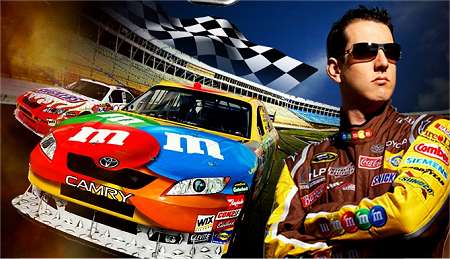
Kyle Busch
Fortunately, I am rescued by a strange little item from Formula1Sport that is restored to full functionality after a week of falling over and staggering about helplessly. It seems that Kyle Busch, current leader of the NASCAR Nextel Cup Series, is negotiating to have a test in a F1 car.
Apart from the interesting thought that negotiations are necessary to get even a test these days, this is a more momentous snippet of news than might be realized at first. As far as I am aware, no NASCAR driver has made the switch to F1 before. Drivers from the past like Dan Gurney and Phil Hill might have raced in both categories but that is not quite the same as a specialist such as Busch taking the plunge. A closer analogy might be, for instance, Richard Petty, the greatest of all stock car drivers in my opinion, suddenly deciding to pack it in and go racing for Team Lotus in 1970. That would have been fascinating indeed!
Looking at the recent converts from F1 to NASCAR, it becomes obvious that the two categories demand very different skills. F1 race winners like Montoya are not really having the impact on NASCAR that we expected and are having to re-learn what amounts to a completely different trade. So how will NASCAR drivers adapt to the requirements of F1?
We might expect that Busch will fail miserably if and when he gets his test for Toyota. He is being realistic about it and knows that it will be a severe test physically at the very least (he mentions neck muscles!) and that is a good place to start from. And it is possible that he might surprise us.
Consider the times that rally drivers have swapped cars with F1 drivers and performed rather better than expected. It may just be that it is easier to adapt from stock-based cars to open wheelers than vice versa. Both stock car drivers and the rally men are used to far less grip than achieved by F1 cars so they must revel in suddenly getting the car to go where it is pointed without fuss. The F1 men, however, might be frustrated at losing all that grip and having to balance the car between sideways success and disaster.
This is all speculation, of course, and Kyle might decide that he prefers to remain in stock cars. But it is a fascinating look at a possible future source of supply of drivers for F1, especially as it might mean that we see Americans involved in the sport again. Who knows? It may be that the success of NASCAR is not entirely the bad news for F1 that we have always supposed it to be.