
Force India and Red Bull are reported to be in talks to end the long arbitration process over the legality of the Toro Rosso cars (effectively versions of the Red Bull chassis). The demise of Super Aguri, also part of the arbitration process thanks to their use of Honda chassis, has made the process easier and an agreement is expected to be reached very quickly.
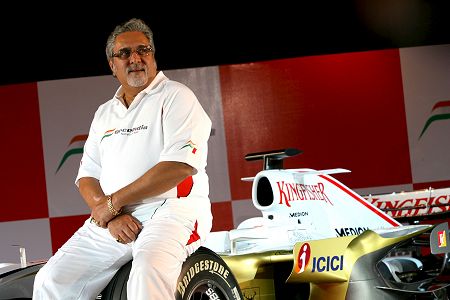
Force India's Vijay Mallya
Rumor has it that Red Bull will be paying Force India the amount of 8 million euros as part of the settlement and I cannot help but wonder whether this even begins to cover the legal costs already incurred by Vijay Mallya's team. As I said in an earlier post, the whole business was ill-advised from the beginning and has played a part in creating the sport's present crisis of shrinking grids; it should have been resolved long ago.
The real death blow to the cause of customer cars was not Force India's arbitration case, however. It was Sir Frank Williams' flat statement that he would take the matter to the courts if Prodrive were allowed to enter F1 with a McLaren chassis. That led to an immediate capitulation by Dave Richards, the Prodrive boss, and other interested parties, including the FIA. Looking back on the events of those few days, it was as if a group of small boys squabbling in the playground had been told that a teacher was on the way to sort them out.
That brings two thoughts to mind. Sir Frank's reaction shows clearly that he has no regard for the internal processes of the the FIA, the WMSC and the Court of Appeal - he knows that the only way to get anything done is to go directly to the legal system outside the sport. And the duck and scatter reaction induced in those trying to gain entry for Prodrive shows that they, too, know that the FIA's legal structure is a joke.
I have written before about the concentration of power in the hands of the president of the FIA being an invitation to trouble; but a large part of the problem is also the Concorde Agreement. Originally invented as a way for the constructors to ensure that the governing body kept rule changes to a minimum and gave reasonable lead-in times for those changes, the Agreement has since mushroomed to take in all sorts of regulatory functions, some in direct conflict with the FIA rules. When it becomes clear that many of its regulations are matters of secrecy, one has to think that something is not quite right. Since when has a sport been run on regulations only guessed at by the outside world?
Max Mosley had a lot to say last year about F1 being brought into disrepute and he is currently being hoist by his own petard on that score. But how much more does the organization itself invite contempt when its structures are so poorly designed and chaotic? Should it really be necessary for participants in a sport to resort to the legal system every time there is a problem of any magnitude?
Having two bodies making rules for one sport is obviously a recipe for confusion and disaster. The embarrassing saga of Mosley's desperate rearguard action against resignation as FIA president is surely a sign that the governing body needs a complete restructuring and clear-out. Part of that should be a return to the old system of the FIA overseeing its responsibilities while more specialized functions are carried out by satellite bodies such as FISA. And those satellites should include representatives, not just from the FIA, but also from the participants. In the case of F1, that would be the team owners and there would be no need for such anomalies as the Concorde Agreement.
Formula One is facing perhaps the most difficult period in its history as it strives to be relevant in the 21st Century. To meet the challenge, it is going to have to be much more efficiently run than is possible in its present structure. It is time that those involved took a step back from their own little realities and came together to create a better way forward for the good of the sport.